Welcome to Korea

I cannot believe I’m on my third day in Korea already! I’m going to split my adventures here so far up into two posts, this being the first.

On Wednesday I flew from Tokyo to Seoul. I scheduled my flight for 11 AM, thinking that would give me plenty of time to sleep in meeting some friends in Shinjuku the night before.
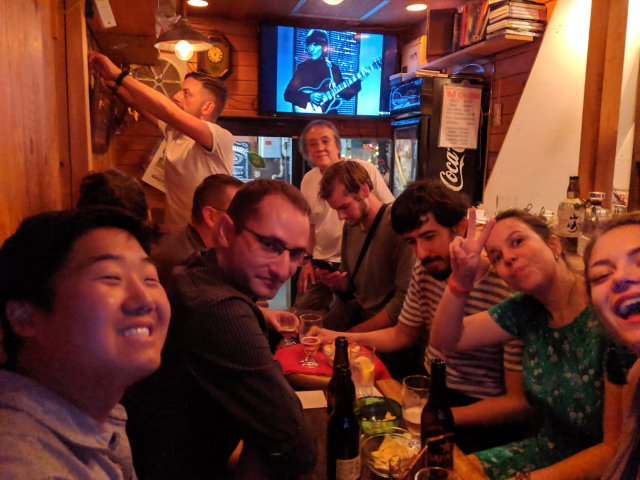
We ended up at a tiny little bar in Golden Gai that we called Sauna Bar because we couldn’t read the actual name and the wood paneling made the inside look like a sauna. The place just barely had room for about 12 people to squish in.

Unfortunately Narita International Airport is way out in the boonies, a solid hour and a half from Shinjuku by train, so I was up and out the door far earlier than I would have liked. Oh well.

A bus ride rounded out my day of planes, trains and automobiles, and before I knew it I was checked into my hostel in Seoul’s Insadong neighborhood. I’ll be here for 6 nights total, which is nice – I’m excited to put down some minor roots and really get to know the area, and to not have to lug my gear around for a while.
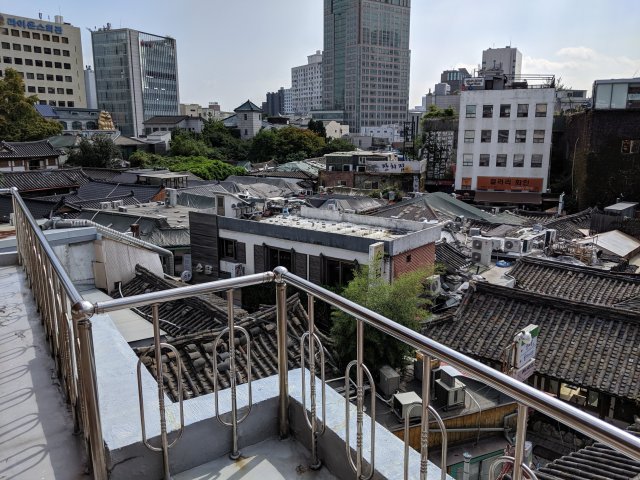
View from my hostel’s rooftop “garden” (I have yet to see a single plant up here).

I met a fellow named Eyal who is traveling from Israel and we decided to go exploring together. We had just wandered through a beautiful shrine and were starting to think about food when a couple of Korean women stopped us in the street. They said that they were Buddhist monks, and asked us if we were visiting Seoul and if we would like to share a Korean cultural experience. My scam alarm immediately started going off – that sounds like the start to all sorts of traveling horror stories. But Korea is supposed to be one of the safest places on the planet and the two of us were together, so we decided to see where it went.

We hopped on the subway, then changed trains. One of the women received a text and had to go off somewhere. By this point I was on high alert, ready to bolt at the first sign of trouble. But we got off in a respectable commercial / residential neighborhood, turned a couple corners and entered an older but well maintained office building. If this was a scam it was a really involved one.

Turns out it was completely legit. We were given traditional robes to put on over our clothes, learned how to do various bows, got a rundown of the ceremony and then we started. The ceremony was all about preparing and blessing fruit as a meal for the spirits of our ancestors, and we were asked to keep prayers in our minds for the health of our families and loved ones. Once it was done we sat and ate the fruit, envisioning our ancestors eating with us through our chopsticks. I’m not sure any of my grandparents even knew how to use chopsticks, but I imagine they would have appreciated it anyhow.

Once we were done the monks politely asked us to make a donation to help support their charitable causes – they run a home for elderly people with alzheimer’s, among other things. I, who had been so worried about a scam earlier, was more than happy to contribute.

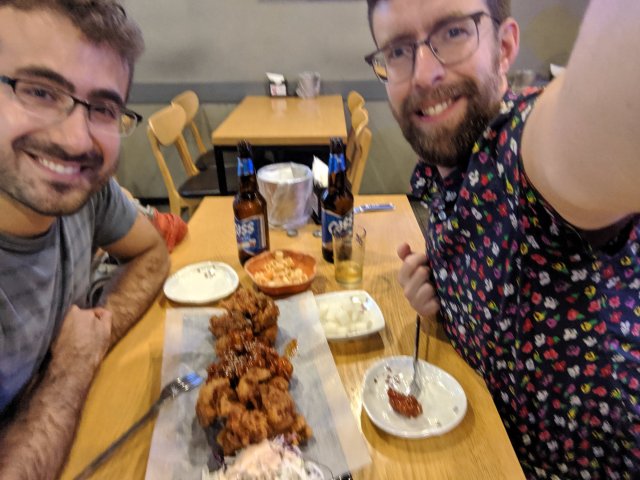
Unfortunately I don’t have any pictures of the ceremony, but here is Eyal and me chowing down on some Korean style fried chicken afterward as we explored Hongdae, the endless neon and pouring rain giving the city a fantastic cyberpunk flare.
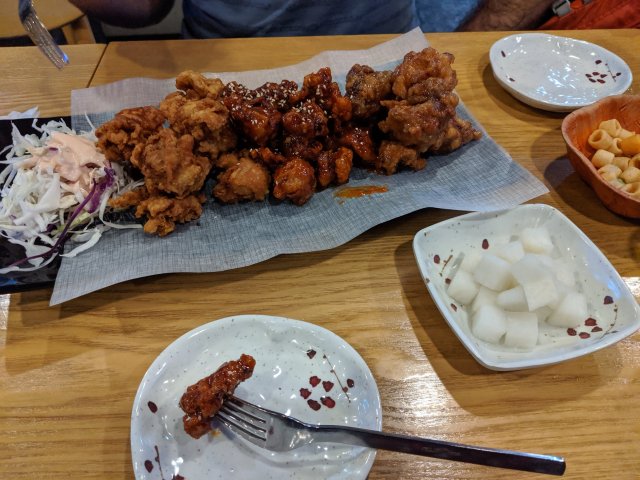
Korean food is incredible, so expect more food photography.

I am enamored by Seoul so far. It is a city of juxtapositions: a flat river valley surrounded by steep mountains, labyrinths of traditional shops that butt up against glimmering corporate skyscrapers, exclusive nightclubs next to tiny and impossibly cheap soup bars, high tech space toilets in the same room as weirdly minimalist showers. Old and new mix in a way I’ve never seen before. I could easily fall in love with this place.

Matsumoto

I’ve spent the last couple days exploring the small town of Matsumoto on my way back from Kamikochi.

Hostel Adventurers

My train got into Matsumoto Station early in the afternoon, and I decided to walk the 3km to the hostel. Rain was threatening to make its way down the valley but I figured I had some time, and I know no better way to become familiar with a place than just wandering around. I pulled up a map and off I went.

40 minutes later I arrive at the hostel. The door is open but the place is deserted – no proprietor, no guests, nothing. There’s a big sign out front of the house and the place is clearly set up for guests, so I’m sure I’m in the right place. Maybe they just stepped out for a minute. I pull out my book (Factfulness by Hans Rosling, which I highly recommend) and settle in to wait.

This hostel is just someone’s house!

A quarter of an hour later there’s still no sign of anyone. I send a quick email to the address on the reservation, then decide to walk 15 minutes up the road to the nearest 7-11 to get some cash and snacks.

In case you’re not familiar with Japanese 7-11s, let me fill you in. 7-11 is owned by a Japanese bank (7-i holdings), and they are much nicer in Japan than State-side. They’re super clean and have excellent snacks including all sorts of fresh things like rice balls with fish. Since they’re owned by a bank, they’re also the most reliable place to get cash with an American bank card (Japan is a surprisingly cash-oriented place).

I just barely beat the rain storm back to the hostel. Still no sign of the owner, nor a response to my email. At this point I’m getting a little nervous – am I going to open up a door and find a dead body? I start the kettle going then settle back in with my book and a cup of tea to wait.

Finally the owner comes in, a tiny little Japanese lady with only a few words of English. She is a little surprised to find me, and informs me that she lives downstairs – all I had to do was ring the doorbell and she would have come right up. Obviously.

Eventually the other guests arrive: an older French couple, their adult son and his Hong Kongese girlfriend. The parents speak only French, the kids French and English. I end up doing a fair amount of translation for them, since my Japanese is better than our host’s English. It’s pretty satisfying to be able to help like that. I’m impressed by the older couple – going to a remote part of a very foreign country with not a scrap of shared language is courageous!

My point, I suppose, is that this kind of thing will never happen if you only stay in hotels. Strikes me as a terribly boring way to travel, frankly.

Addendum: as I was sitting in the hostel finishing up this post, the owner’s husband wandered in with a carton of sake, and we proceeded to toast each other and trade travel stories for a while. What hotel would give you that?

Carton sake: the Japanese equivalent of box wine.

Exploring Matsumoto

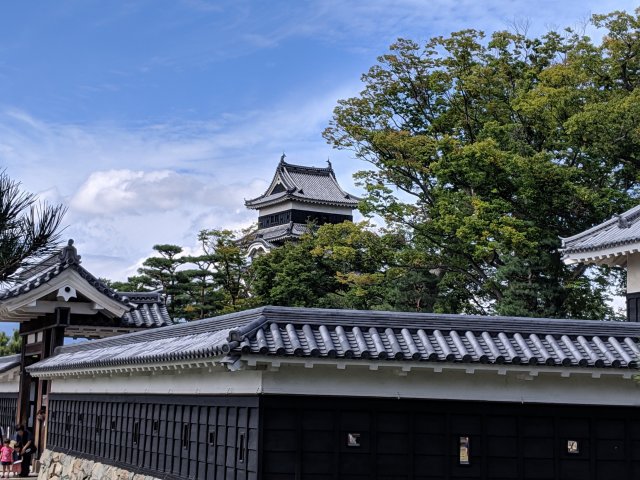
OK, on to Matsumoto itself. I borrowed a bike from the hostel to get into town, then spent the morning at Matsumoto Castle. This is supposed to be Japan’s second best castle after Osaka Castle, and I would say it lives up to the title.

I wandered around town a bit, and got a lunch of Zaru Soba (cold noodles dipped in sauce). The place had a sign outside reading “we cannot speak English, so in order to provide good service we can only serve Japanese speakers”. It almost scared me off until I remembered that I speak Japanese! Also they had an English menu so I don’t know what they were on about.

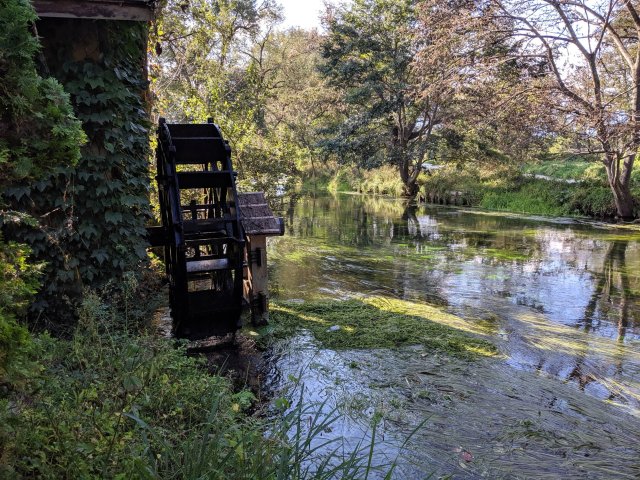
After lunch I took the train up the valley, rented a bike and visited the Daio Wasabi Farm. A friend had recommended it to me, and it was definitely worth a visit. Wasabi (real wasabi, not green horseradish like you get most places) is extremely demanding to grow – it needs specific conditions, including a constant flow of high purity water. The farm has an impressive irrigation setup, and it made for some impressive scenery.

They installed several water wheels to be used on the set of the Kurosawa film “Dreams”. As far as I can tell they don’t actually do anything, just look good.

I still had a couple hours on my bike rental, so I made a big loop of the river junction, riding on little farm roads. It kind of reminded me of riding in Indiana in college, but with better colors and less head wind.Now I’m back in town, wolfing down some okonomiyaki (think of a cross between an omlet and a pancake) at a tiny place near the train station called “Octopus and Whiskey and Soda”. Not a bad way to finish a day.Tomorrow I head back for a final night in Tokyo, then I’m off to Korea.
Getting to Kamikochi

If you’re traveling through Japan, trains are the name of the game. Tolls and high gas prices make driving expensive, and driving on the left hand side is dangerous if you’re not used to it. It’s also very convenient – the transit network here is so vast you’d have to work hard to find somewhere it couldn’t take you that a car could. In fact, you cannot drive a private car into Kamikochi National Park, it’s transit or bust.

To get to Kamikochi, your first stop is the town of Matsumoto, Nagano Prefecture. Matsumoto is something of a regional hub, so how you get there depends on where you start – Google Maps is your friend. From Tokyo, I took the Chuo Limited Express train, which leaves on the hour from Shinjuku station. The fare was 7200¥ (about $70) each direction, and the trip took about 2.5 hours. I booked in advance through the JR East website, but there were plenty of seats on my Friday morning train if you’re into winging it.

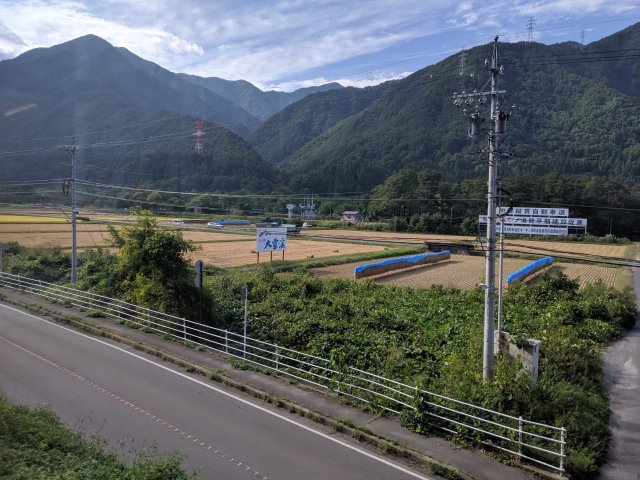
Trains are a great way to see the countryside. Forgive the camera’s reflection.

If you’ve already got a JR pass then this ticket should be covered. But if this is your only major train trip in Japan, it’s way cheaper to get individual tickets than the full pass. The JR pass really only saves you money if you plan on taking the bullet train.

Scenery so pretty you’re glad it’s not a bullet train.

Once in Matsumoto, transfer to the Matsumoto Dentetsu Kamikochi line headed for Shin-Shimashima, right at the foot of the mountains. The train is 700¥ each way, and takes about half an hour. I also had a 45 minute layover in Matsumoto, but I’m not sure if this is always true.

View from the local train.

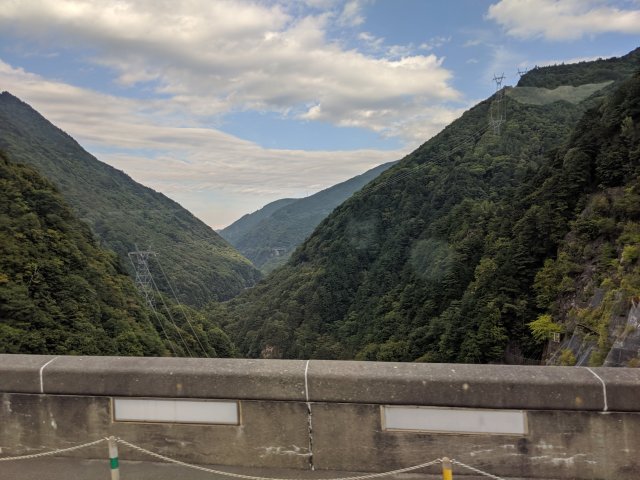
The train line ends at Shin-Shimashima, so you’ll have to transfer to a coach bus. You can buy a ticket right at the station, and they have a bus waiting when the train arrives. The round-trip bus fare was about 4500¥, and the trip took about an hour. This is far and away the most impressive part of an already beautiful journey, as the bus winds its way along a twisty road up a steep mountain valley full of lush forests and imposing hydroelectric dams.

Bus view.
View from the top of a dam.

There you go, now you’re in Kamikochi. The whole trip from Tokyo takes about 5.5 hours, and costs just over 10000¥ ($100) each way.

Yakedake

Today I climbed a mountain!

The mountain is called Yakedake, and it’s in Kamikochi National Park, Nagano Prefecture, Japan. “Dake” means “peak”, which is why it doesn’t get a “Mount”, a “Yama” or a “-San”.

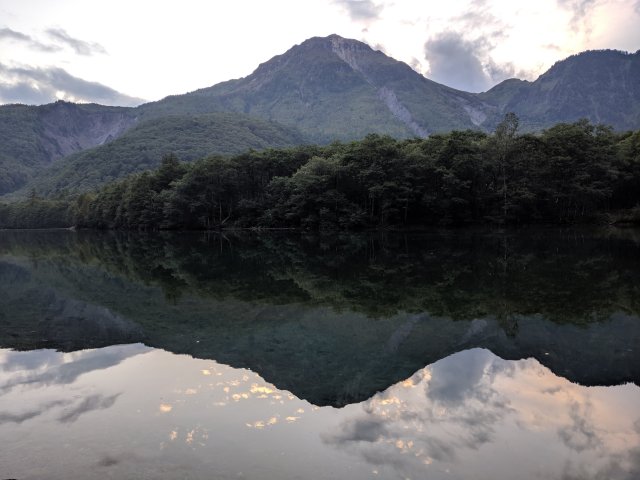
Yakedake from across Taisho-Ike pond, taken last night. Of course I had clear weather on my travel day.

A bit of residual jetlag helped me get up bright and early, and the trailhead is 200 meters from my hotel, so I borrowed a pair of mismatched hiking pills and was on the trail satisfyingly early. And what a trail it was. Straight up the hill, sometimes literally!

Yep, that ladder is the trail.

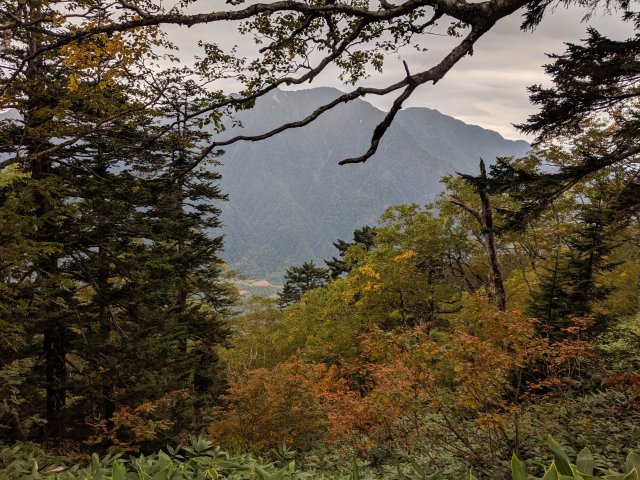
The leaves were just staring to turn, and bamboo as a ground cover instead of whatever random brush we get in Washington made it feel just a bit exotic.

About 2/3 of the way up was a little mountain hut, with a latrine, a basic bunkhouse, and dry goods for sale. Kind of a funny thing to see kilometers from the nearest road. They had similar way houses in Scandinavia, but I at least haven’t seen anything like this back home.

Yakedake Goya

The summit was a couple more steep kilometers (no more ladders though). Of course a huge cloud rolled in just as I was making the final ascent, so I only got a quarter of the panoramic view. It then disappeared 20 minutes after I left the peak. Typical.

Yakedake is an active volcano. It last erupted 2500 years ago, but it shakes every couple of years, and the place is convered in steam vents.

Yakedake’s crater – that’s a steam vent on the bottom.

Being a masochist, I decided to take the long way home, winding my way along the ridge to the next mountain hut, then back down into the valley. When I asked at the hotel, they said “危ない, 気を付けて” (abubai, ki o tsukete) about the ridge section – dangerous, be careful. 危ない is a tricky word though, dangerous is the literal translation but it tends to indicate something that’s unfinished and not for regular use, like a torn up sidewalk or a fire escape. Since they didn’t add anything more than “be careful”, I decided to go for it.

Turns out “unfinished” is a pretty good translation in this case. The trail was easy to follow, but rough and quite strenuous. When I saw on the map that it went along the ridge I expected PCT-grade, but this was an unending stream of brutal ups and downs.

And they call it a trail!

Speaking of which, I’ve been pretty pleased with how quickly my Japanese is been coming back. It took a couple days, but this morning I was able to turn a crappy map and a non-English-speaking concierge into a good amount of information about my route, including difficulty, needed supplies and the availability of food and water.

Finally I reached the junction and found the next way house, Nishino Sanso. This one was more of a lodge, with a full restaurant and a big bunkhouse. Everything is kind of expensive – the place is run by volunteers but it’s still tricky to get things up there. I had a bowl of soup and a cup of coffee for lunch for 1200¥ (about $12), then filled up one of my my water bottles for 200¥ and used the bathroom for another 100¥. I get it, the idea is to prevent you wasting resources you don’t need, but it felt a little like they were nickel and diming me. Still, it would be great to spend the night up here. Maybe next trip.

It started to rain while I ate lunch.

Then down down down back into the valley, losing a vertical kilometer over just 3km of trail. I think more of the trail was stairs than not. Someone needs to tell their version of the WTA about switchbacks.

Welcome to the woodland realm. We have stone stairs, wooden stairs, root stairs, earthen stairs, and very steep sections of non-stair trail.

Finally finally finally I reached the trailhead, and immediately sat down with a beer. My legs are jelly, my knees ache, my calves are cramping up, and I am terribly pleased with myself. All told, I don’t know how far I traveled. Despite looking all over the place I was not able to find a good topo map with distances or elevations, and the map I got from the hotel listed distances in terms of walking time. They were spot on – I was on the trail for 7 hours not counting lunch, just as predicted – but that doesn’t help me figure out my pace. Ah well.

One last view of the valley.

I think the best way to sum it up is that I had an adventure today. Some parts were incredible, some parts were a little miserable, and I’d do it all again in a heartbeat. Just give me a day to rest first.

In other news, I learned a couple of new words today. Draft beer is 生ビール, “namabiiru”, and bottled beer is 瓶ビール, “binbiiru”. The more you know…

Packing

Fall has arrived, and with it my departure. I can’t believe my flight to Tokyo is tomorrow! I’ve been running around like a chicken with my head cut off the last few days getting things ready to go – visas, insurance, last minute planning, and of course packing.

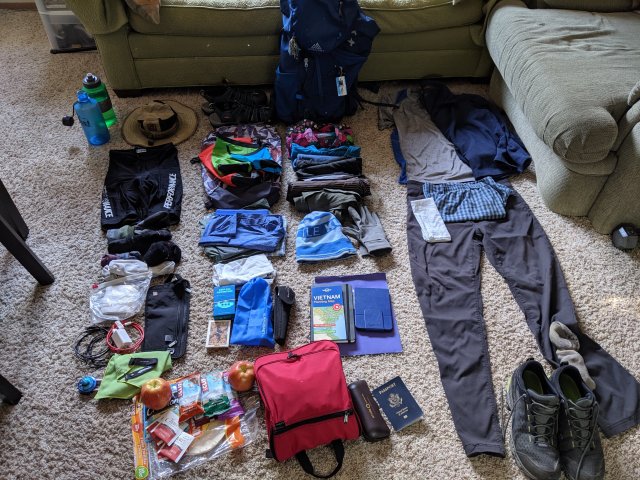
Everything I need for 3 months abroad. Believe it or not, all of this will fit in that little blue 40-liter pack.
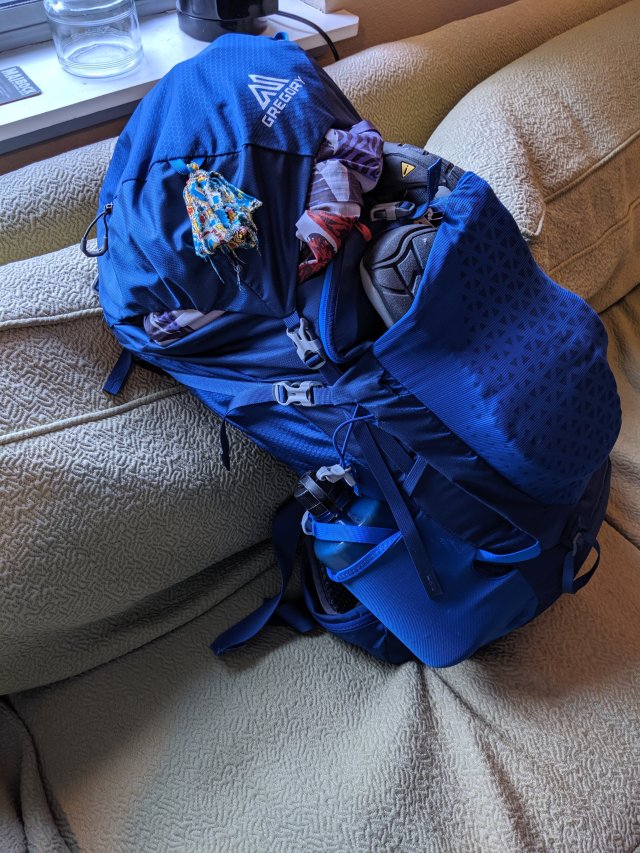
Packed and ready to fly!

My first stop is Japan. I’ll spend one night in Shinjuku before heading up to the mountains for some hiking, fall colors and hot springs. The weather forecast calls for thunderstorms and pouring rain, so maybe more of the latter. Wish me luck!