The Vietnam War

(this one gets a little preachy – you’ve been warned)

Imagine, if you will, a bad science fiction movie. Evil aliens have invaded the Earth. Their motives are unclear but their goal is simple: subjugate the human race. They come with advanced technology: fantastic flying machines, impossible bombs, chemicals that destroy the environment and cause children to be born with terrible illnesses. They treat us cruelly, burning our towns and villages, making no distinction between soldiers and women and children. Worse, they have recruited some humans as allies, using them to do much of the dirty work. But the human race is not quite so easy to conquer. Fighting tirelessly over 30 years, a group of cunning soldiers led by a charismatic leader manage to overthrow the oppressors, destroying their tools of war and sending their army back to their home planet in tatters, never to trouble humanity again.

That’s basically the plot of the Vietnam War – just replace “alien” with “American” and “human” with “Vietnamese”.

It is difficult to travel to Ho Chi Minh City without thinking about the Vietnam War. Even the airport hints at it – the code SGN refers to Saigon, what it was called before it was renamed to honor the father of the Vietnamese Communist Party after the reunification. Two war-focused sites top most lists of tourist attractions in South Vietnam: the War Remnants Museum and the Cu Chi Tunnels.

The War Remnants Museum is located in the heart of Ho Chi Minh City. It has a large outer courtyard filled with American armaments abandoned after the war: airplanes, a helicopter, tanks, artillery, bomb casings. The 9-year-old in me was delighted, but it’s hard to read about hundreds of tanks, thousands of artillery pieces and bulldozers, and hundreds of thousands of rifles without wondering how much they cost. How many teachers, nurses and social workers we could have hired with that money, how many schools and bridges we could have built with that steel?
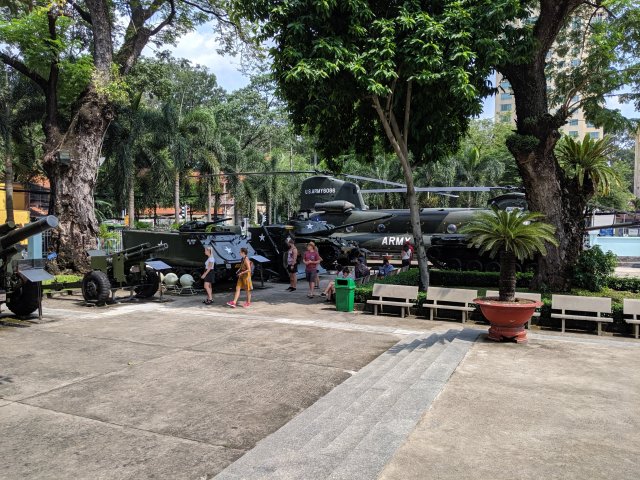
Inside the building were a number of well-put-together exhibits. There was a tribute to combat photographers. Sections on the My Lai massacre and the effects of Agent Orange turned my stomach. There was a moving room dedicated to anti-war activists both in the civilian population and within the military, reminding us that organized protest can and does change the world for the better, even if it takes a while.

That evening, I discussed the museum with a few Europeans on the roof of the hostel, none of whom knew much about the war going into it. “Surely,” they said “it couldn’t have been that bad. At least some of this must be propaganda. History is written by the victors, after all.” Some probably is, particularly the omission of any atrocities carried out by the NVA, but from what I remember from high school history and what I’ve read since the depiction of the American side of the war war is pretty accurate. The fabricated casus belli, the incompetence of military leadership, the shortage of discipline in the ranks, the blatant disregard for the laws of war, the tremendous economic damage and general human misery of engendered are all well documented. As much as I’m a lefty pacifist, I think it’s a pretty well accepted fact amongst Americans that the Vietnam War was a giant, shameful mistake on the part of our country.

The other attraction is the Cu Chi tunnels, more than 100 km dug with hand tools by the Viet Cong in the area northwest of Saigon, a critical part of their guerilla war. There are exhibits on booby traps, an opportunity to fire an AK47, and of course the tunnels themselves. The parts that are open to tourists have been widened and had lights installed and they’re still terrifyingly claustrophobic. I cannot imagine being down in the deep bunkers (9m underground) for extended periods hiding from an American bombing run.
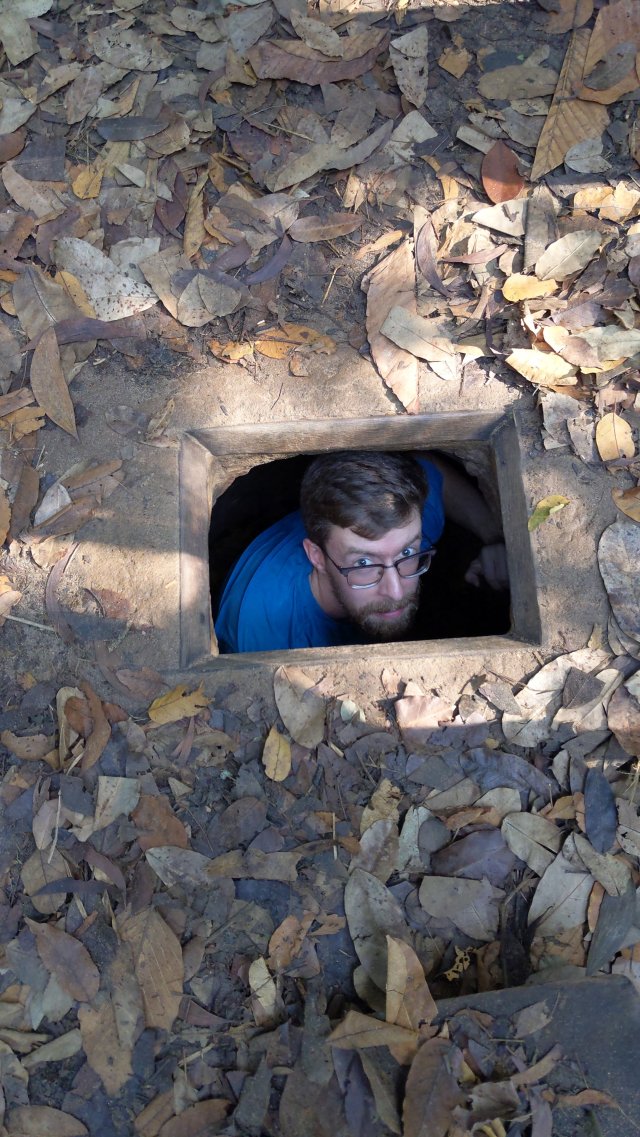
The focus on the VC experience was a nice counterpoint to the War Remnants Museum (which focused on the American side), and really showed the desperation and determination of the North Vietnamese fighters. I guess that’s the difference between fighting an unjust war on foreign soil and fighting to defend your homeland from invaders. For them, there was no such thing as “do your tour and try to make it home in one piece”.

From these two war museums, I have two conclusions. The first is that war, or at least a war of aggression, is unacceptable – it’s ruinous for everyone involved, except perhaps for whoever owns the weapons factory, and there is no end that justifies such a terrible means.

The second is that standing up to tyranny works. Whether it’s a group of scrappy guerrillas fighting back against the world’s most powerful military, or a group of concerned citizens protesting against the world’s most entrenched military-industrial complex, you have more power than you think.

Status update

In case you’re curious what I’m doing, I have left Ho Chi Minh City and traveled about 300 km northeast by bus to the town of Da Lat. Known as the city of flowers, Da Lat is a smallish town way up in the hills (elevation 1500 m) and so has a much more temperate climate than the cost (I even wore a sweater this evening). It’s a hub for outdoor sports, including hiking, canyoning and white water rafting. I’ll spend a few days here before heading back to the cost and continuing north toward Hanoi, where I intend to arrive by the first of November.
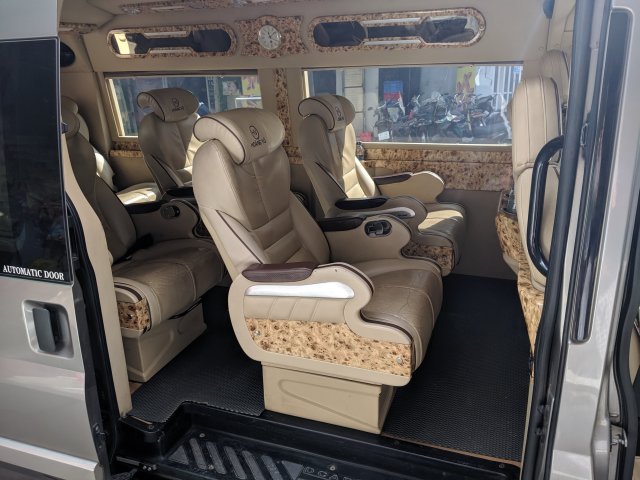
Some bus!
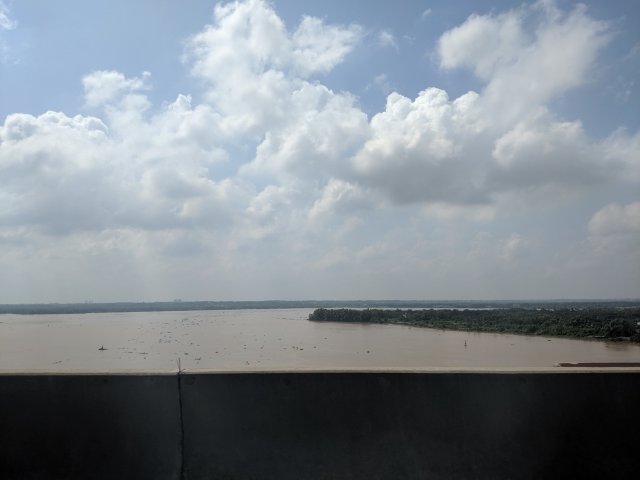
Crossing the river out of HCMC.

As cool as Saigon was, with a vibrant energy and fantastic food, I was ready to leave after just a few days. Staying there was exhausting. I am ready now for a relaxing stint out in the country.
Saigon

Saigon. Ho Chi Minh City.

It is a city to inspire poetry.

It is beautiful, chaotic, overwhelming, but not inscrutable. It is dirty but not filthy, maybe cleaner than New York. The people do not live big, but they seem to live well. Vietnam is a socialist nation, but here capitalism thrives on a micro scale.

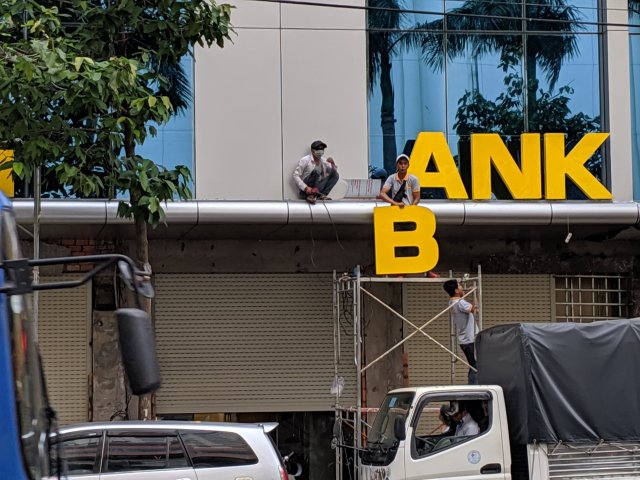
The B is going up, not down.

There are two types of street in this city. On the broad boulevards motorbikes swarm around cars and busses, and tiny businesses spill onto the sidewalks, pushing pedestrians onto the street. Dried goods, fruit, motorbike repair, books, bahn mi, cigarettes, beer. Crossing one is an act of faith: wait for a break in traffic, then start walking. Keep your pace and you’ll be fine – linear motion is easy to predict, and no one wants to hit you. The most dangerous thing you can do is try to dodge.

Turn left or right between the intersections and you’ll find yourself weaving through impossibly tight passageways between overhanging buildings. Though they are barely wide enough for two people to walk shoulder to shoulder, business spills onto the street and mopeds squeeze past pedestrians. The path twists and branches. Most routes lead back to the street but every once in a while you find a dead end, and must swallow your pride and backtrack.

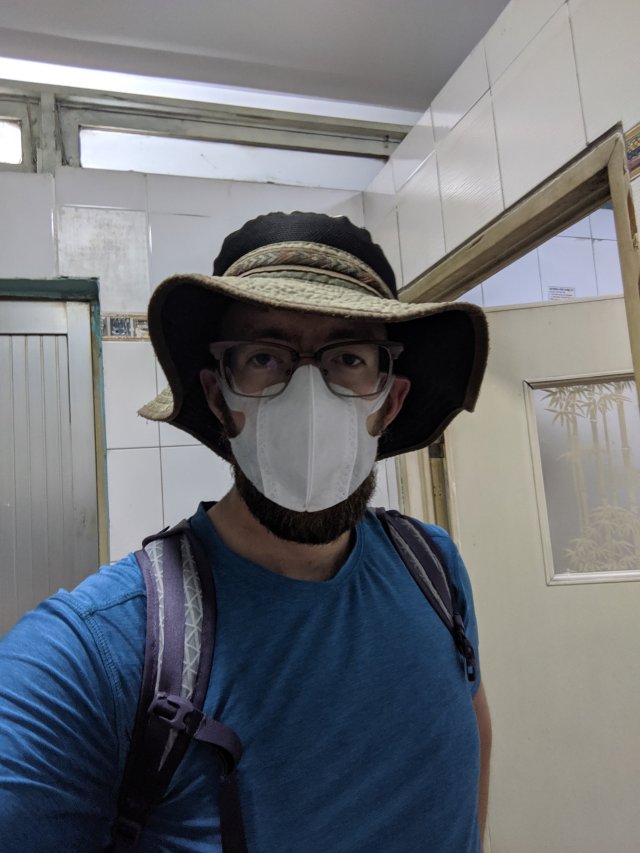
It is hot, muggy, the air reeks of pollution. A morning of wandering the city and my lungs are aching. I buy a cotton surgical mask from a tiny store, the kind I have seen many locals wearing. It is comically small, not even covering my chin – I think I have accidentally bought a child size. My beard breaks the seal and makes it itch terribly. I wear it anyway. Perhaps later I will find a bandana.

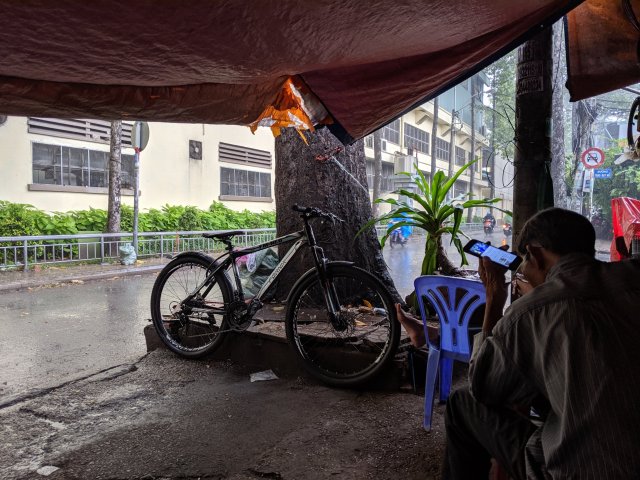
A storm threatens to break out; I duck under a tarp and order a beer just as the rain begins to fall. Somehow, as if by prearrangement, the driver of every motorbike and vespa is immediately wearing a poncho. I sit on my child sized plastic chair next to an old timer. We cannot speak to one another, but the atmosphere is friendly. We adjust our chairs to avoid drips in the tarp. The waitress brings out my beer along with a glass of ice, which I have forgotten to tell her to omit for fear of infection. I drink the beer warm, straight from the bottle, slightly ashamed of my waste. Thunder peals, and we watch it pour.

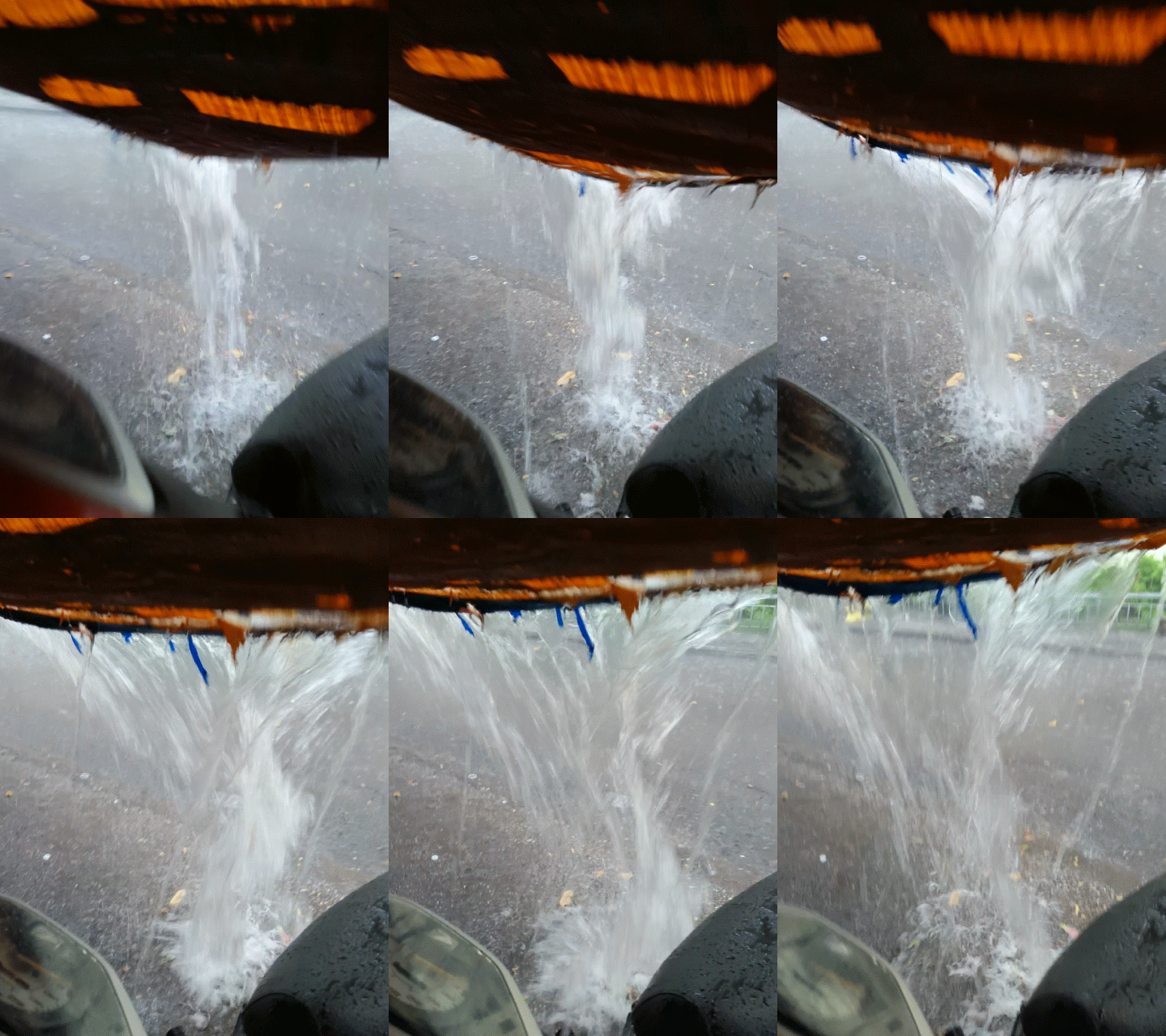
The tarp looks weirdly like it’s on fire here, but I assure you that is impossible.

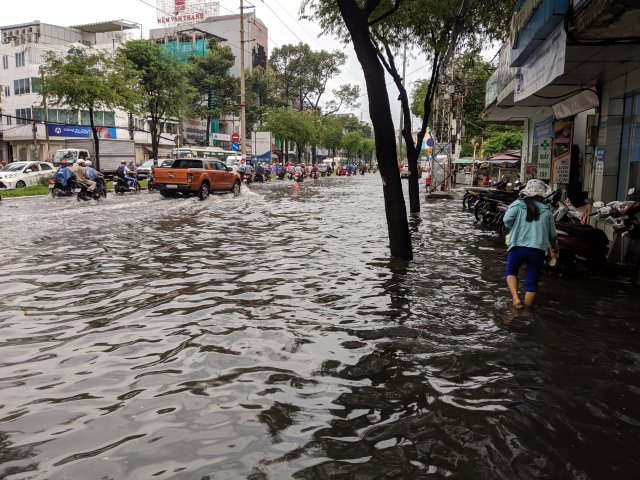
It rains harder than I have ever seen. The streets collect inches of water. The flood threatens to overflow onto the sidewalk where I sit. Vespas throw up huge rooster tails as they speed by. The locals seem unimpressed.

As soon as the rain eases the streets drain, leaving them clear of dirt but scattered with trash that has washed out. I’m not sure if it’s better or worse. At least the rain seems to have cleared the air a little – it is cooler and easier to breathe than before. My friend pays and takes off on his moped; the owner casts the dregs of his beer into the street. I nurse my second bottle and wait for it to subside to a drizzle before I settle up. The price for shelter from the storm: 20,000 dong, less than a dollar.

I wander the streets as the city drips. My vague destination is Chinatown and the Binh Tây Market, but I am in no hurry. Enterprising shopkeepers hurry with brooms to clear their sidewalks of trash. Traffic ebbed a little with the rain, but now it is back thicker than ever. Several blocks of a major boulevard are flooded. Undeterred, motorcycles speed by, the water over their drive trains. I have no hope of crossing and there are no convenient side streets to duck down. I wade through half a block of shin-deep dirty grey water before I can turn down an alley. The locals wade with me; seeing their cheap plastic flip flops or bare feet I am grateful for my sturdy sandals.

This street is full of steel workshops, churning out every kind of part imaginable in tiny first floor workshops. Sparks fly as people weld, cut and shape. I see neither safety glasses nor work gloves, though the welders do wear masks.

Suddenly starving, I turn into a corner cafe and order a bowl of pho just as another deluge starts. The hot soup is a perfect counter to the pouring rain.

I finally make it to the market. It’s late enough that many stalls are closing up, but I purchase a little pair of scissors to trim my beard as well as a bandana. I even haggle a little bit, just to prove I can.

I take the long way home, along the canals to the south. This is not as simple as it sounds – bridges are scarcer than I would like and some roads are so busy as to be uncrossable on foot. More than once I have to backtrack substantially. The neighborhoods are residential, not rich, but I don’t feel in danger. In fact I get a number of “hello”s and “welcome to Vietnam”s as I wander. As darkness falls however, I worry about walking down the still busy roads – even here in the boonies there’s little room on the sidewalk for pedestrians. I spot a well-lit cafe and stop for dinner, thinking I’ll hop on the wifi as I eat and figure out how to get home quickly.

The restaurant’s waitstaff are all young men, and they are all somewhat effeminate. One might even say beautiful. They bustle around me, giggling as I confront the all-Vietnamese menu, showing me in detail how to cook meat in the hot pot and wrap it into a fresh roll. I also attract some attention from the next table, a gaggle of Vietnamese men and women, clearly a little drunk, who call out questions and laugh at my responses. Most lose interest quickly as they run out of English phrases, but one in particular is persistent. His friends leave, but he moves to my table. He has no more English than they do, but he keeps pestering me. I start out all smiles, hoping to avoid things getting ugly, but it doesn’t feel like he’s trying to pick a fight. Finally I arrive at the obvious conclusion: I have stumbled into a gay bar, and this man is aggressively hitting on me. I’m pretty sure he’s trying to get me to pay him for sex. A resolute “no” gets me nowhere. I book a motorbike taxi through an app under the table, flag down my waiter and shove a $20 in his hand, and get out.

Many thoughts pass through my head as I cling to the back of my driver. I feel betrayed – what I thought would be a safe haven for a weary traveler ended up being anything but. I’m frustrated with myself for not seeing what was going on sooner. I’m grateful that this is the first time I’ve felt unsafe on this trip, and that I got out ok. But mostly the feeling is “oh wow, this is what it’s like to be a woman all the time”. Fuck that.

It is a relief to return to the hostel, to relax on the roof and not have anywhere to go next, to chatter in English with the Brits and the Australians and the Danish woman whose diction is better than mine. To take a shower, paying careful attention to my feet. It has been a busy first day in Saigon.

Getting lost in Bukhansan National Park

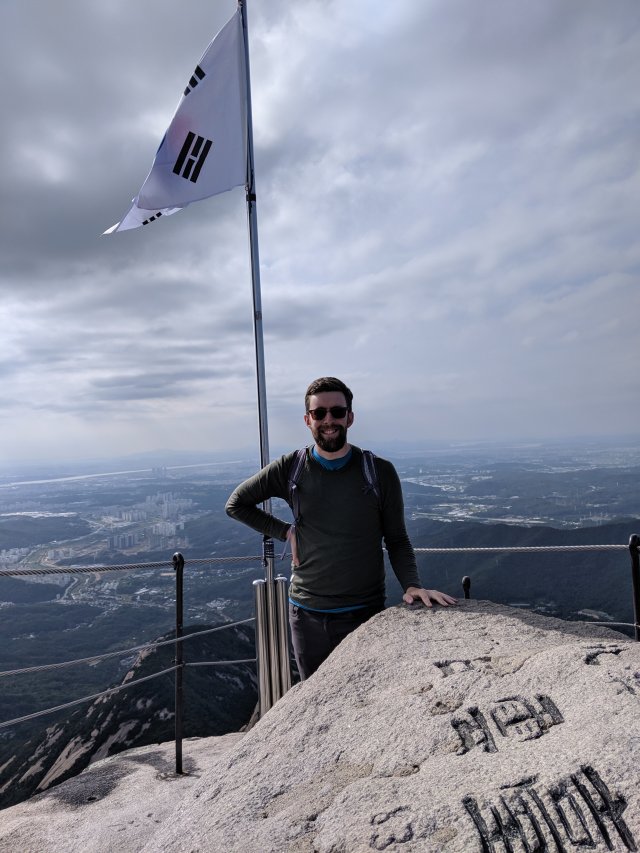
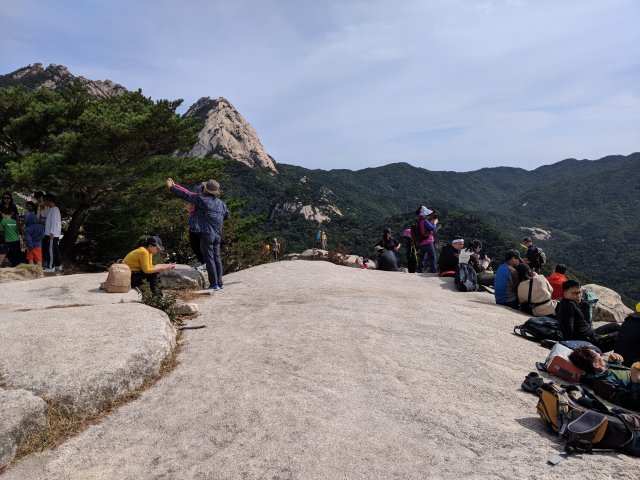
Today I climbed a mountain!

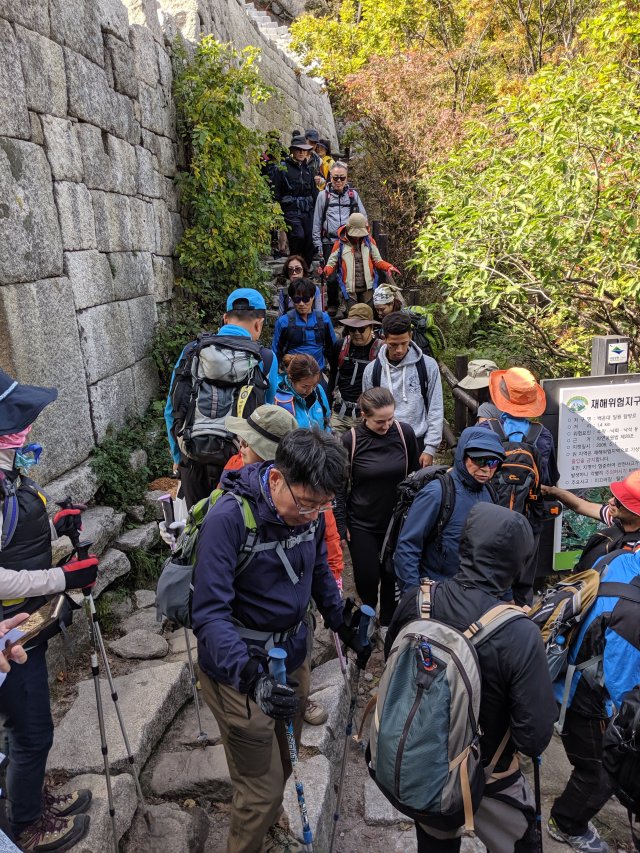
The mountain is called Baegundae in Bukhansan National Park, just north of Seoul. The park is practically in the city – suburbs wrap around 3 sides of it, and there’s a bus that runs directly there from my hostel.

I got lost, but I did make it to the summit first.

Because of its proximity to one of the biggest cities in the world, Bukhansan has more visitors per square meter than any other national park in the world. Plus I visited on a beautiful warm weekend day right at the end of the summer. So you might say it was a little crowded.

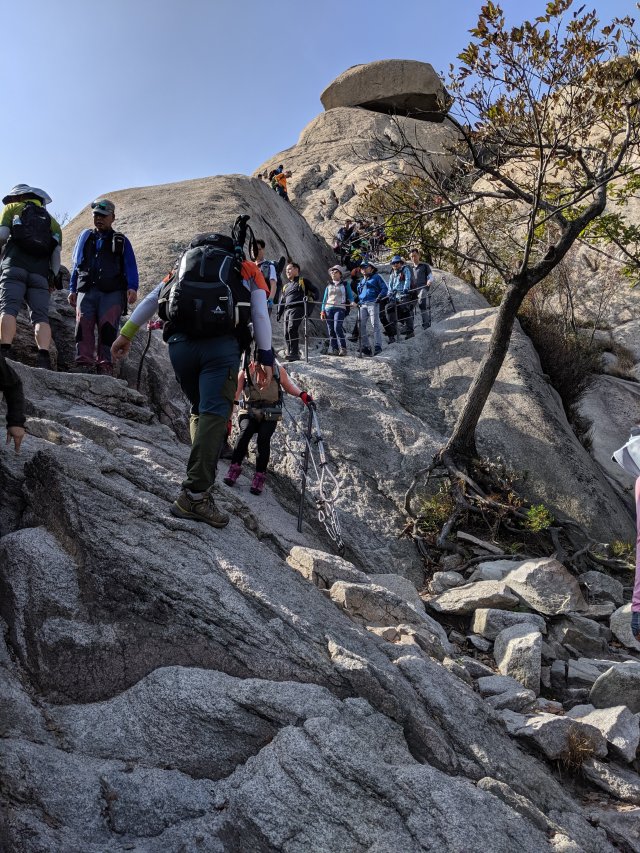
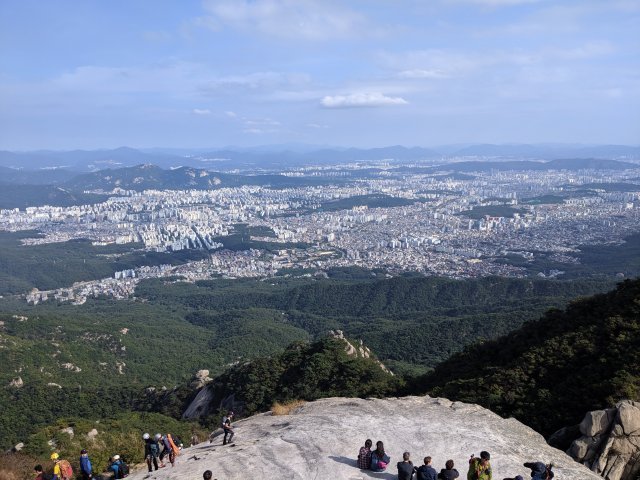
I would compare this hike to Mt. Si in Seattle, both in (theoretical) length and difficulty, and in its phenomenal view from the top. Maybe it’s more crowded, but I haven’t ever been to Si on a sunny weekend.

So how did I get lost on a trail this crowded? It took a perfect storm.

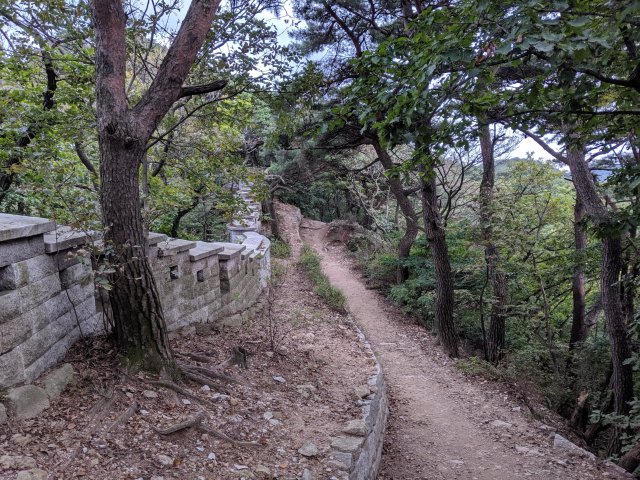
First, there are multiple ways into the park, and many loops and interior destinations. The whole mountain range was originally a fortress / temple complex, and there’s much more to it than just the climbing course. My plan was to take the steep path up and the long but easier path down.

Second, signage was incredibly poor. Direction posts were inconsistent in what they pointed to, and the maps posted at trail junctions showed different landmarks. I started with a solid idea of what I wanted to do, but figuring out how that matched up with the trail on the ground was tricky.

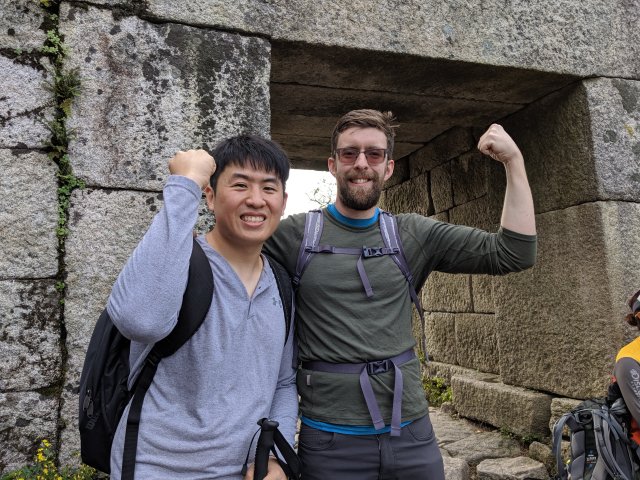
Third, I met a friend. Just after reaching the summit, I ran into Min Koo from the Purdue marching band. I would have walked right past him, but he somehow picked me out from the crowd despite me growing a beard and us not having seen each other in 6 years. We caught up a bit, and then I asked him what was the right way down the mountain, just to double check. What I did not tell him is what entrance I was headed for, and when he told me the opposite of what I thought I was just able to convince myself it made sense.

Boiler up!

So, I had myself yet another adventure. I got all the way down to the parking lot on the other side. A wise man would have called it quits and figured out how to bus home, so of course I headed back up into the hills down another path that I was sure would get me to where I started.

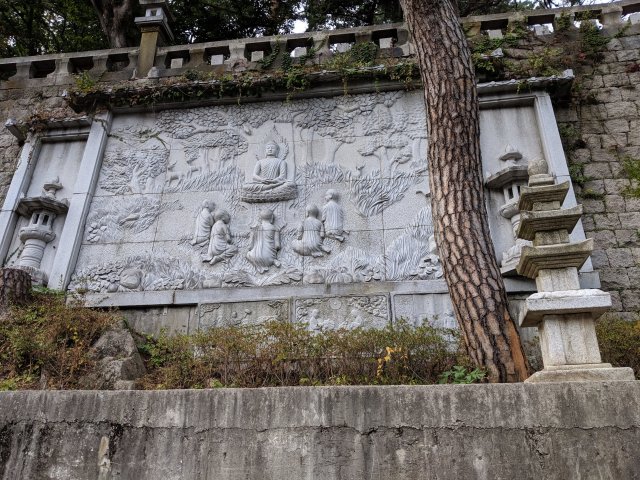
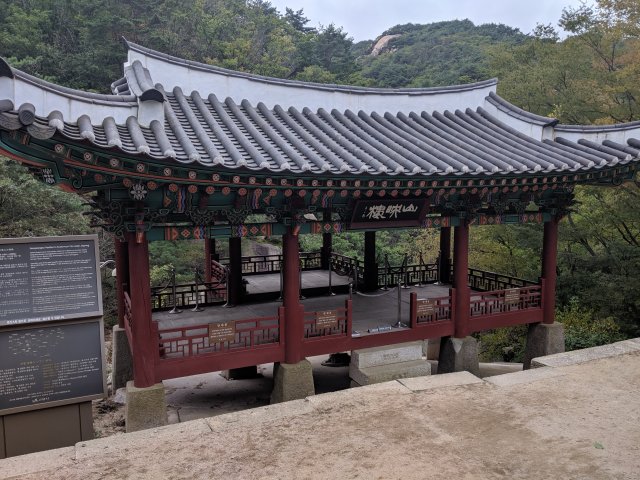
It did, but it took a while. Along the way I stumbled upon an incredible temple up in the hills, along with a park ranger who didn’t speak English, but I’m pretty sure was trying to tell me the sun was going down and I needed to hurry my butt up. I asked him “Bukhansanseung?”, the name of my destination, and he said “ok go fast”.

So I did. I booked it over the lower pass, picked up the trail I intended to take from the start, and made it down just as twilight was setting in. But the crowds weren’t quite finished with me.

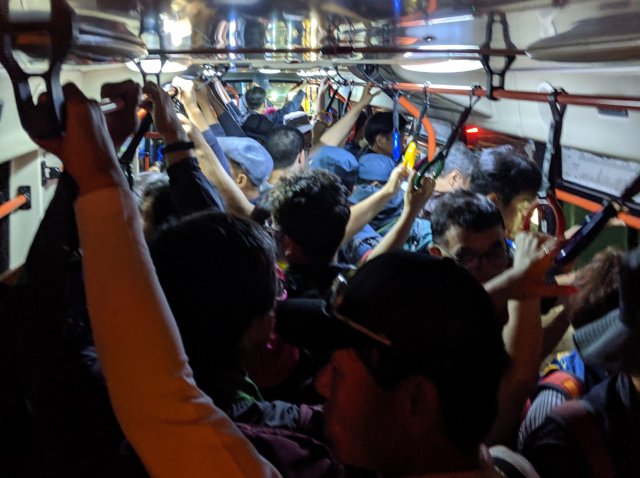
No rest for the weary – standing room only on the bus back into town. Every one of us had hiking gear on.

Not a bad day all in all, but tiring. Next time I go up I’m going to bring a good map.

한글

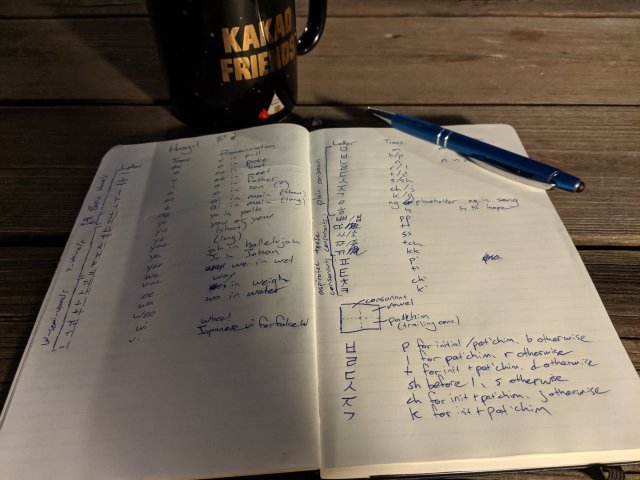
한글, or Hangul, is the Korean alphabet. I’ve been spending a little time learning it while I’m here, and while it looks complicated and difficult, with some practice I found it pretty straightforward.

Hangul is an invented script, as compared to most other writing systems which evolved organically over time. It was designed with the express purpose of being easy to learn, replacing Chinese characters which took lots of time and training to master. It’s phonetic like Latin or Arabic, as opposed to pictographic like Chinese.

The script consists of 6 basic vowels and 10 basic consonants. The shapes of the letters match up with how you move your mouth to say them. Each of those can be modified in certain ways (adding a y to the start of a vowel, for example). These are combined into syllable blocks, each of which has a starting consonant, a vowel, and an optional ending consonant. Add in a few rules to make things easier to pronounce, and you’re pretty much there.

With just a couple hours study, I’m to the point where I can slowly sound out what I see on signs and menus. My Japanese knowledge has been very useful in figuring out pronunciations, since many sounds are transliterated in the same way. The next level would be to get to the point where I’ve chunked all of the possible blocks and don’t have to read individual letters, similar how to you don’t think about letters when you read an English word, but I doubt I’ll get enough practice in my one week here to make much progress there.

The skill isn’t quite practically useful yet, but it makes the world feel a little less inscrutable. It’s especially fun when I discover a transliteration of an English word and can actually understand what I’ve read.

A Korean Trump Rally

My first full day in Korea was a national holiday. My plan was to go explore Gyeongbokgung, the national palace. But I got a little sidetracked.

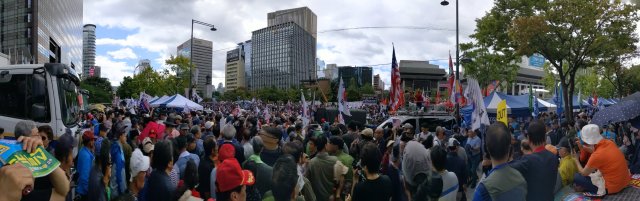
I heard a huge amplified voice and a bunch of chanting and singing coming from somewhere, and decided to follow it and see what it was. Turned out to be a political rally, Korean and American flags everywhere and signs printed in Korean. I found a wall to sit on a little way back from the crowd and decided to see where it went.

Soon I was joined by an older Korean gentleman, who introduced himself as Choonmyun and explained in broken English (probably better than my Japanese) that this rally is to call for the ousting of South Korean president Moon Jae In. Why, I asked. What’s he done that’s so bad?

Why he’s ruined the economy, pushed away the United States and Japan, and is talking about peace with the North. Xi Jinping (China’s president) is laughing, he loves it! The young people, they don’t understand, they don’t remember how bad things can be. We must have Moon out now!

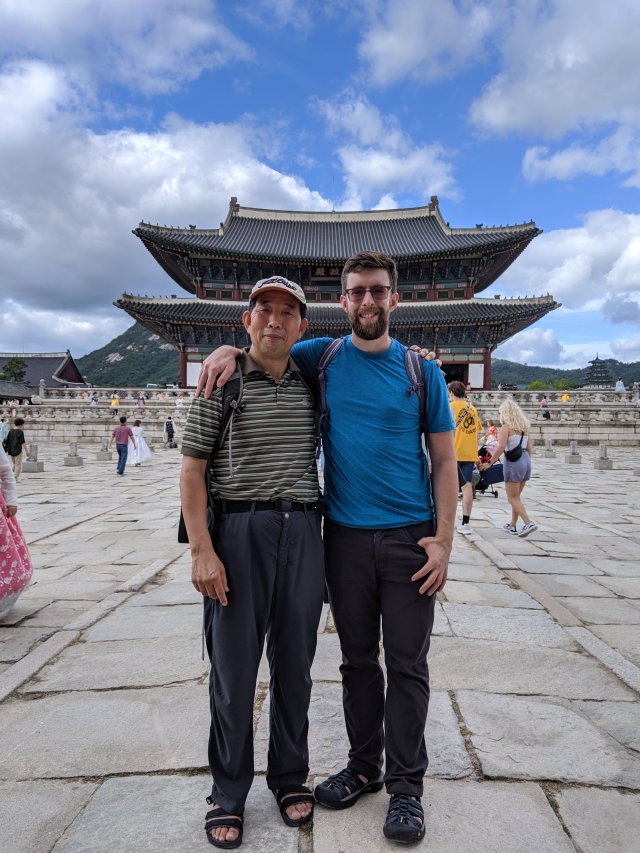
My friendly Korean guide Choonmyun. I think the sign reads something like “throw Moon in jail”.

Hmm, interesting. According to Wikipedia, Moon is a liberal elected after the previous conservative candidate was impeached in a corruption scandal, who’s done things like substantially raising the minimum wage, reducing the maximum work week (to 52 hours from a jaw-dropping 68 previously), been aggressive about limiting the power of chaebol (Korean mega-conglomerates like Samsung and Hyundai) and pushing for peace with the north as a route towards denuclearization of the Korean peninsula. Sounds like exactly the sort of fellow I would vote for, frankly. Plus it doesn’t feel particularly respectful to travel to a foreign country as a guest and then promptly call for the downfall of their head of state. But given the context, I kept my opinions to myself and waved my sign as little as I could get away with.

(Choonmyun if you’ve somehow stumbled onto this blog, I’m really sorry that I wasn’t entirely truthful. It felt bad, but by the time I knew what I had gotten myself into it was too late up back out gracefully.)

The rally itself was interesting to see. Most of the attendees were older, and there were a lot of veterans. There was a lot of chanting and militaristic singing, and the rhetoric (as translated through my Korean uncle, as I’ve been thinking of him) was violent and angry but not necessarily well thought out. Moon is a North Korean spy, throw him in jail! America is a great ally! Let’s go kick Kim Jong-Il’s ass! Lots of slogans, not much nuance. So exactly like a Trump rally. I got a lot of first bumps and high fives just for being American.

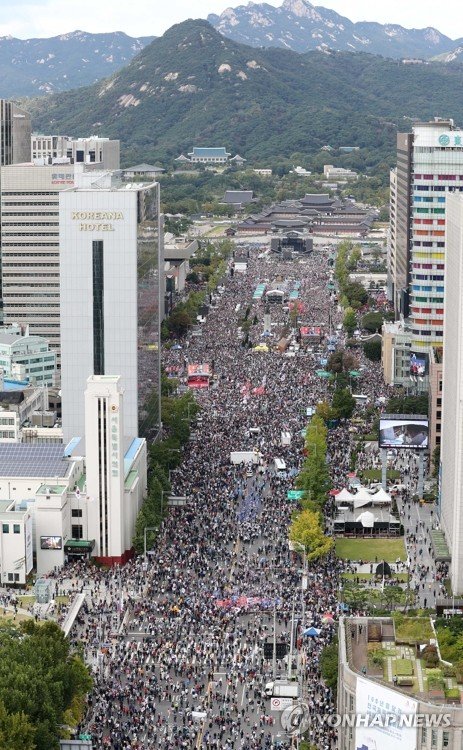
This was a big rally, maybe as many as a million people turned out. Credit: Yonhap news.

Like most Trump voters I’ve met, my Korean uncle was an absolutely wonderful human being despite his politics. After an hour or two of sitting in the hot sun, we decided to ditch the rally and wander over to the big palace. It was really beautiful, a sprawling estate full of stately architecture and fantastic colors.

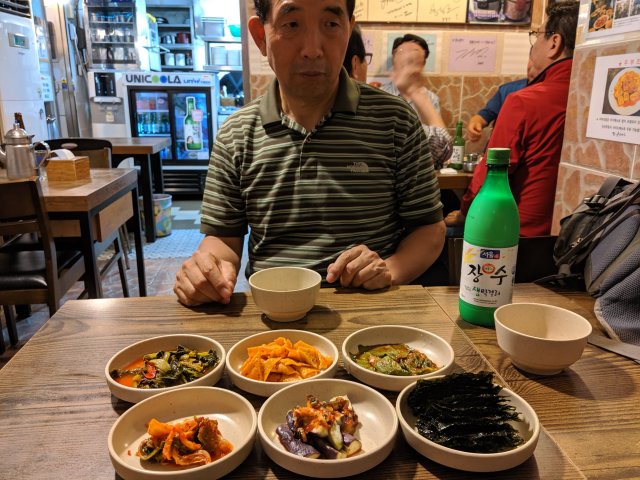
After the palace we decided (naturally) to go have a drink. He led me deep into the Insadong neighborhood then down a set of stairs that looked like a utility access point into a broad underground market. We passed tiny stalls selling everything from fresh fish to textiles to dried goods. We ended up in a tiny little restaurant in the corner that had clearly never even heard of an English menu, and he proceeded to order… something delicious.

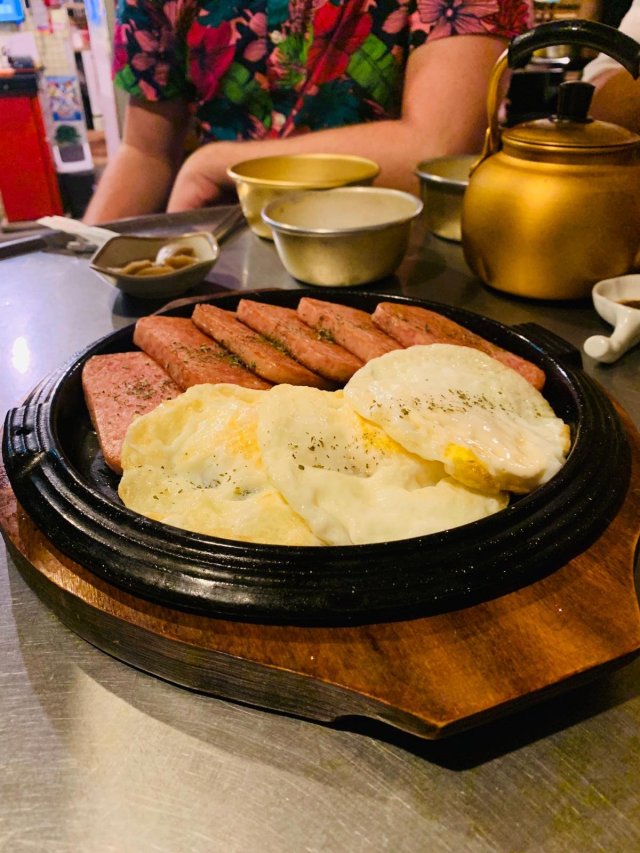
A typical Korean restaurant meal consists of a bunch of appetizers (kimchee, sea weed, spicy bean sprouts, etc) plus a main dish. The apps are free and have infinite refills. The drink is called makgeolli or makkoli, it’s fizzy and sweet and you can barely taste the alcohol, and Choonmyun says its a cheaper way to get drunk than either beer or soju.

Before long I had to take my leave to get to my evening plans, but I made uncle Choonmyun promise to look me up next time he’s stateside.

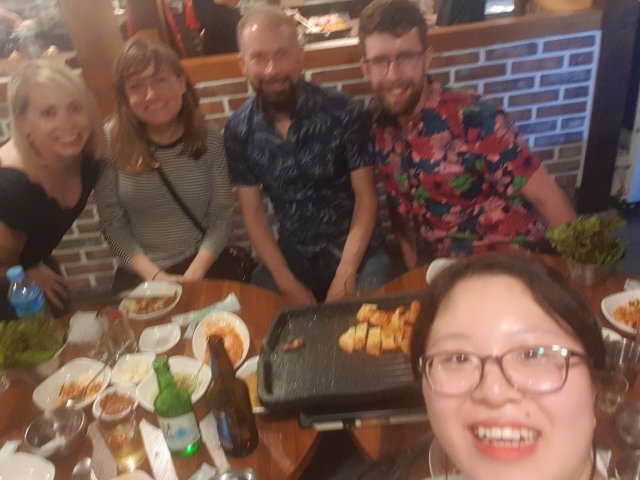
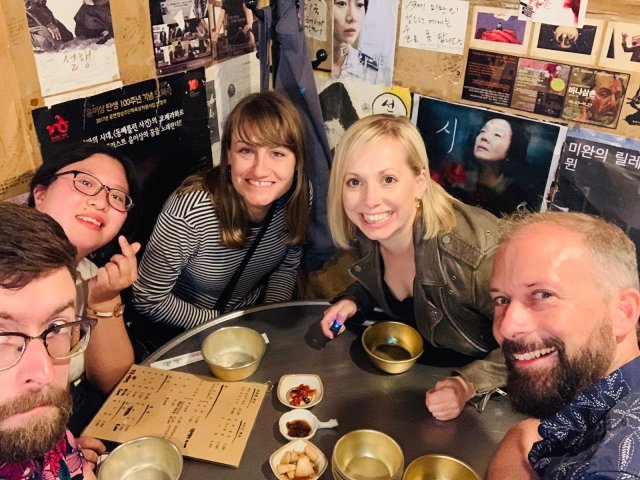
In the evening, I went on a food tour. This is one of my favorite ways to explore any new culture, and I’ve never been on one that I didn’t enjoy. This was no exception and I, a trio of brits and our Korean guide had a blast eating and drinking our way through the town.

Today I was going to go on a tour to the DMZ, but it was canceled due to the African swine fever situation. I haven’t gotten the impression that anyone else is worried about it, but I guess the relationship between the two countries is still really fragile. It’s disappointing, but it’s also provided a much needed opportunity to rest and get some planning and blogging done.

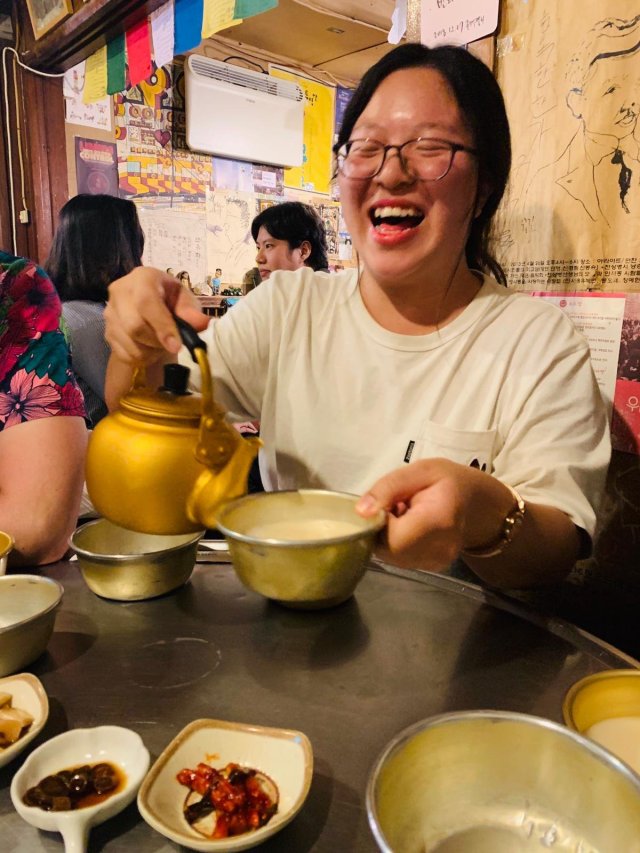
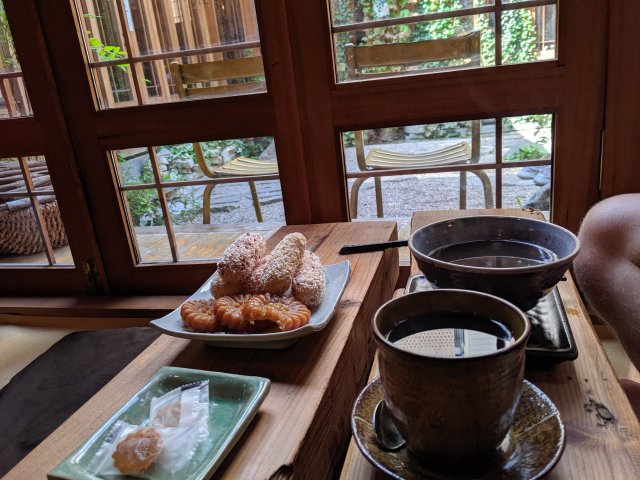
Afternoon tea in a beautiful tea house.