Mt. Kinabalu

Hello from Malaysian Borneo! This was a last minute addition to my trip – I had originally planned to work my way south through Thailand and peninsular Malaysia to Singapore, but I’ve met enough other travelers who were raving about Borneo that I figured I had to give it a shot. Orangutans, giant flowers that smell like corpses and one of the tallest mountains between the Himalayas and Patagonia are all right up my alley, plus part of the goal of this trip is to be spontaneous!

Well, spontaneity seems to have backfired a bit this time. Borneo is currently smack dab in the middle of its rainy season, which means I’ve traded the clear blue skies of Northern Thailand for a heavy marine layer and intermittent downpours. I did not do my research, instead assuming the whole of Southeast Asia would follow the same climate pattern. It’s a solid 2300 km between Chiang Mai and Kota Kinabalu, about the same as Seattle to Minneapolis, so clearly that assumption doesn’t make any sense. Blame it on my imperialist first world upbringing, I guess. At least it’s still warm.

Being me, I decided to face the weather head on and go climb a mountain.
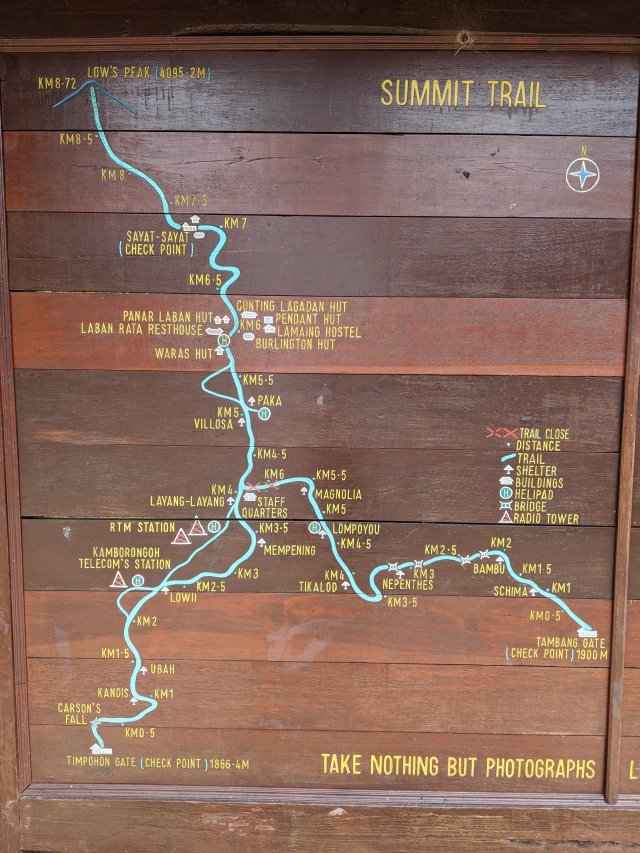
At 4095 meters (13435 ft) Mount Kinabalu is the tallest mountain in the Malay Archipelago. It’s also taller than anything in Indochina or Australia, making it the biggest peak in this part of the world. It’s just a little shorter than Rainier, but it’s tropical location means it’s snow-free year round, and the climb is not technical. The Malaysian government requires that all climbers have a permit, which in practice means climbing with a guide over two days.

Our guide Sylvester.

In addition to our Malaysian guide, the group consisted of two Danes, a German and me. We were one of only two English-speaking groups on the mountain, out of maybe 50 or 60 climbers that day. The climbing outfit picked the four of us up from our hostels on Wednesday morning and drove us to Kinabalu Park, where the trail began at about 1800 meters elevation.

The squad in action.

I was a little nervous as we set out. I’ve done a lot of hiking but little proper mountaineering, and it’s been difficult to keep up my regular exercise schedule while traveling. Would the team leave me in their dust? Would my asthma kick up with the elevation and prevent me from summiting? The description on the guide’s website didn’t allay my fears:

There are many who underestimate the intensity and difficulty of hiking up Mount Kinabalu. Even if one has a vast amount of experience in hiking, please note that Mount Kinabalu is going to be a different experience. It has been reported that, hiking Mount Kinabalu is equivalent to squeezing 5 days of hiking in any of the great mountain ranges into just 38 hours!

On the trail, it quickly became clear that I needn’t have worried. Though the others in the group were fit, I had far and away the most trekking experience, and after getting permission from our guide I quickly ranged ahead up the well-maintained trail. As my mother always says, when the going gets steep (and oh was this steep) everybody needs to go their own pace, anything else will make everybody miserable.

Almost as soon as we hit the trail it started to rain, and it alternated between drizzling and pouring the entire day. The trail turned to a stream, and everything not covered by my rain jacket got completely soaked. It was wet enough that I didn’t dare take my phone out of my dry bag for photos.

The first day’s trek was about 6 km, up to 3270 meters (about 10000 ft). The first 5 were fine, if quite steep. But at around the 5 km mark the trail passed 3000 meters, and I began to really feel the elevation. That last kilometer took almost an hour: take a few steps, take a few breaths, take a few more steps. Still I had made good time – when I reached the base camp just before 2:00 I was one of the first climbers to arrive; about an hour later the rest of my group came staggering in.
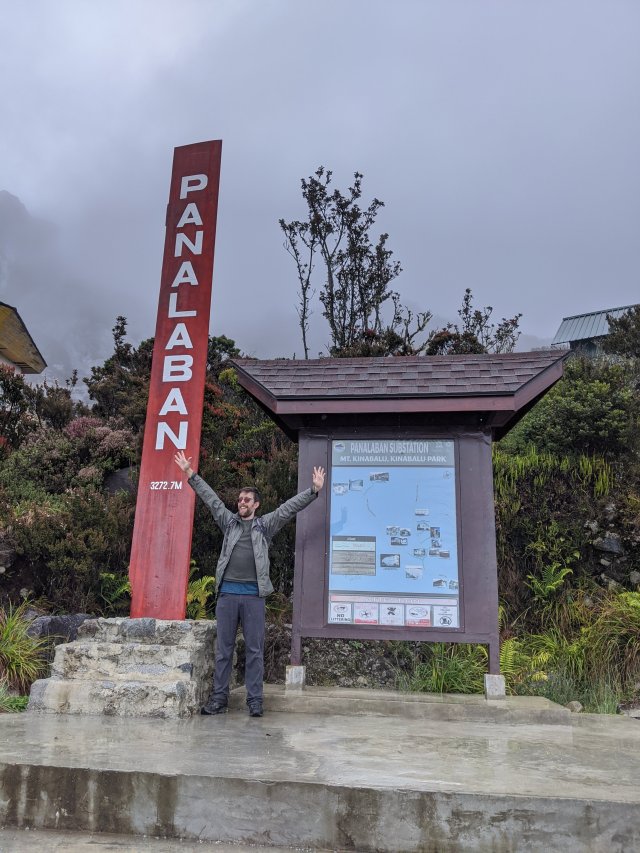
At the midpoint!
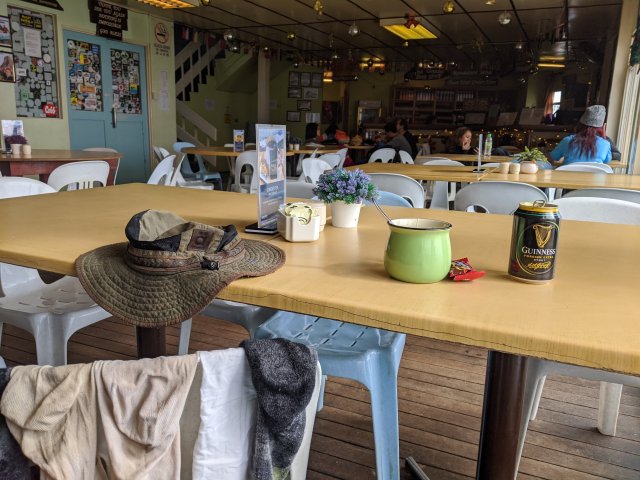
Warming up with a lovely mug of ginger tea as I dried out my socks.

We ate an early dinner, then hopped into bed for a few hours sleep. At 2 AM on Thursday morning we awoke, ate again and begin our attempt on the summit for the dawn.

The clouds had cleared overnight, giving us a beautiful full moon to aid our headlamps, and the pre-dawn climb was quite peaceful. I had acclimated after the long rest at elevation, and though I was breathing harder than normal I wasn’t gasping. Again I sped ahead of the rest of my group, passing many Malaysians struggling up the steep route to the top. At around 5:25 I was in the first cluster of hikers to summit, half an hour before dawn. 4095 meters, just 8.5 km from the trailhead.
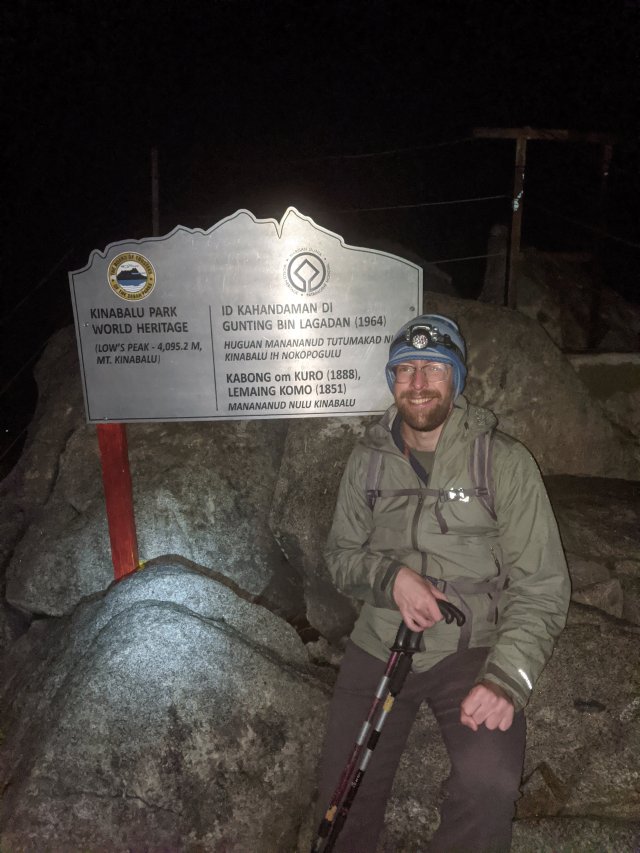
At the peak.
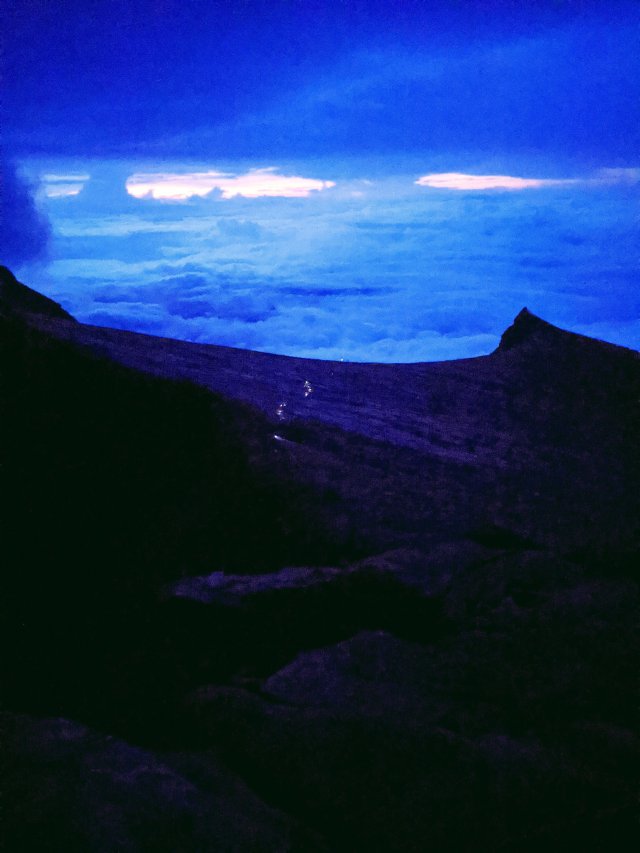
Climbers and their headlamps splayed out behind us in the pre-dawn light.
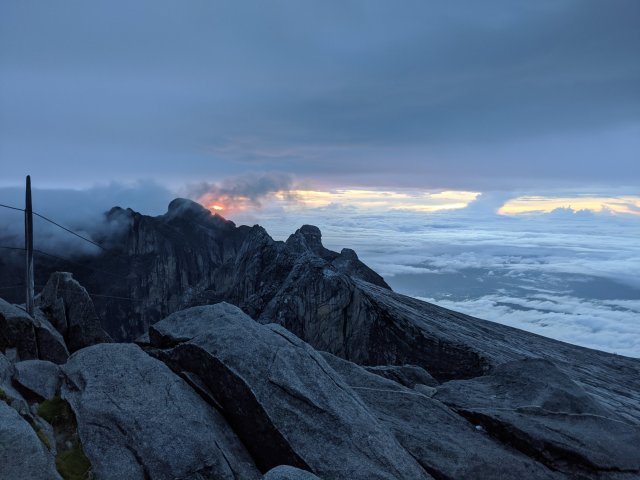
This is about as much of a sunrise as we got. Still beautiful (or maybe that’s just the endorphins).

It was cold at the summit, just a little below freezing. Not much compared to a northern mountain to be sure, but for the second time in a week I was grateful for my warm layers. The cloud cover had returned as we climbed, and instead of warming rays the day brought only a cruel wind and bitter freezing mist. I gobbled down a snickers bar and got the heck off that ridge, snapping pictures as I went.
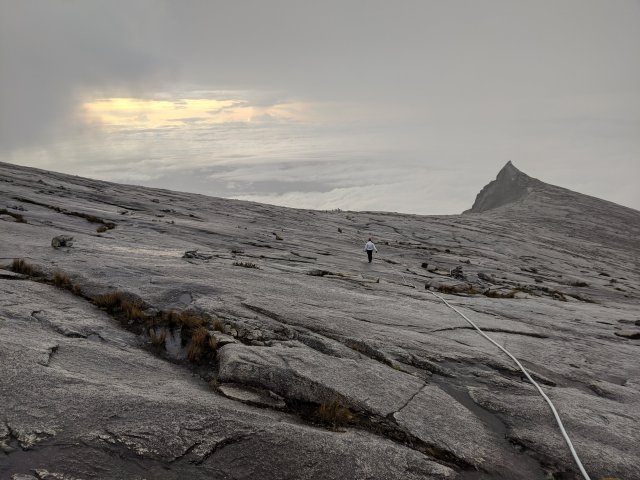
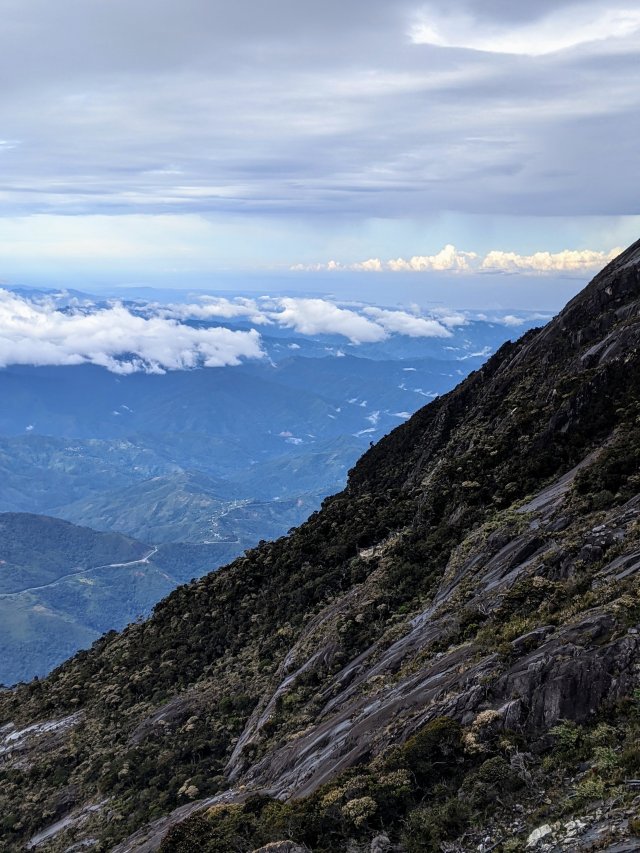
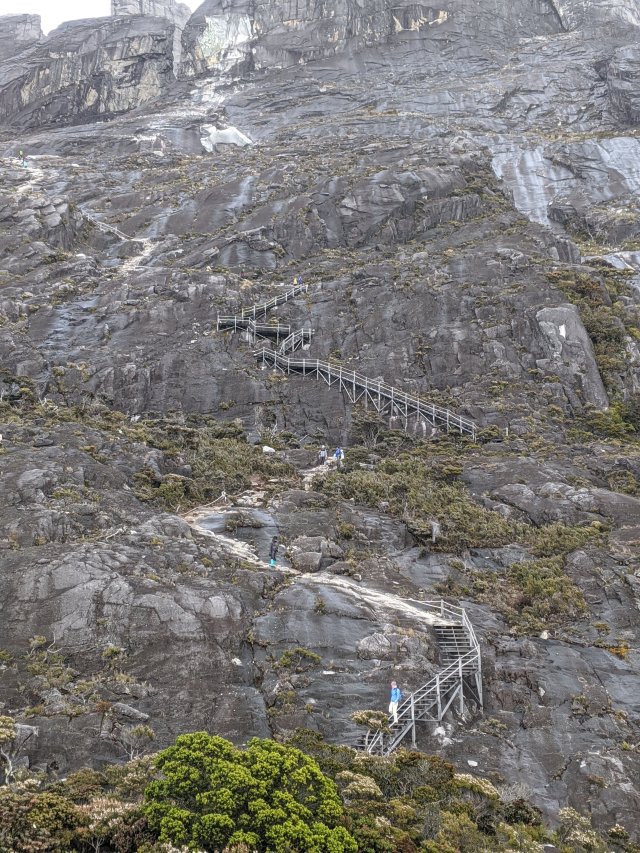
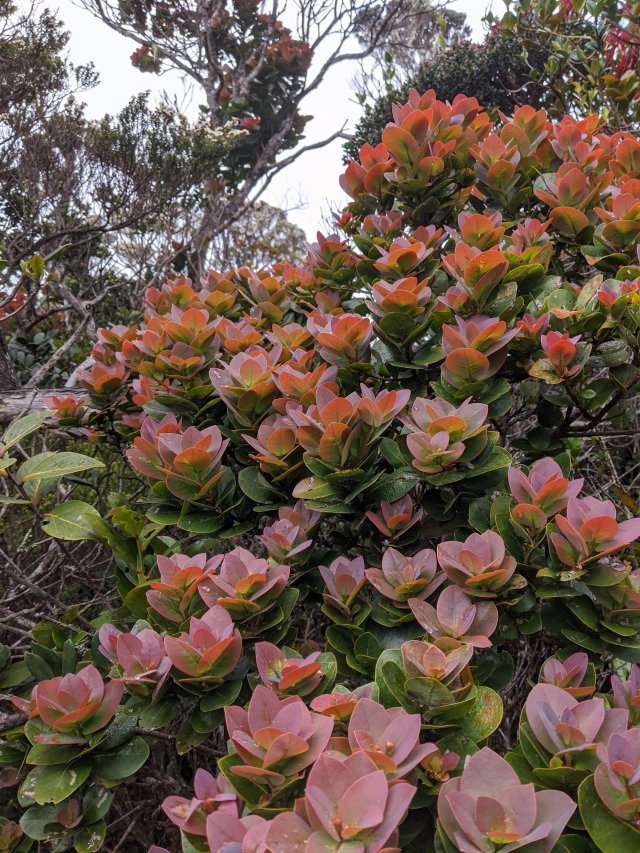
Breakfast back at the lodge was a welcome chance to warm up, then we repacked our bags and started the final trek back down to the road. The weather was cloudy but mostly dry, and I got a chance to photograph some what I missed on the way up.
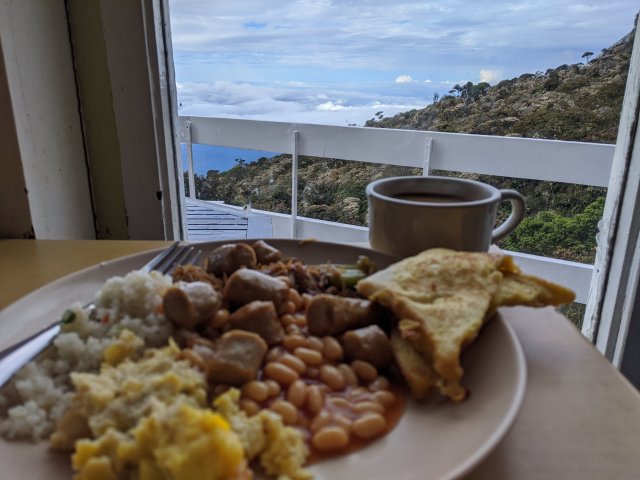
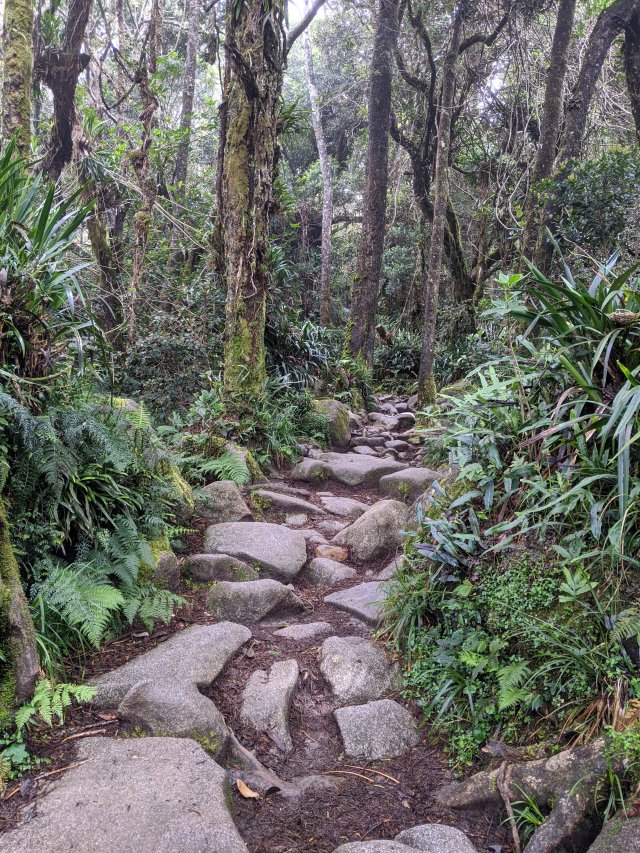
This time I really tried to be patient and stick with the group, but with 2.5 km left to go I finally got sick of their exhausted pace and went down to wait for them at the gate. Holding myself back for safety on the steep slippery rocks that last chunk took me about 50 minutes; it was another 45 before they appeared. I will forever be grateful to Sylvester for trusting me to go do my own thing.

With a total of 17 km (10.5 miles) and 2200 meters (7200 ft) elevation gain, this was definitely the steepest hike I’ve ever done, though far from the longest. Just based on the numbers I suspect I could have done it as a long day hike, though I’m not experienced enough with altitude to be sure. Would pausing for an hour or two at lunch have been enough to acclimatize? Maybe, maybe not. Still, the overnight stay and pre-dawn ascent were a pretty cool experience, and it’s not like I’m in some kind of a rush.

Besides, I’m plenty sore even without a punishing pace.
Pai

Note: this post was written on Dec 9, but due to poor internet connectivity it did not get uploaded until the 12th.

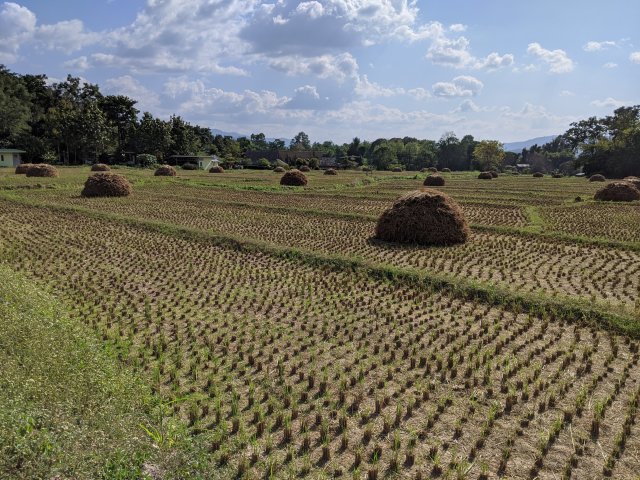
Pai is a small town in Northern Thailand, in the mountains near the border with Myanmar. A three hour van ride over a windy mountain pass will get you there from Chiang Mai, making it remote but accessible. The town is a backpacker’s paradise, featuring plucky hostels, cool bars, boutique restaurants and an incredible night market full of delicious cheap food.

The hostel, Spicypai, was a 15 minute walk out of town.
Quaint bungalow-style dorms – note the extra blankets.
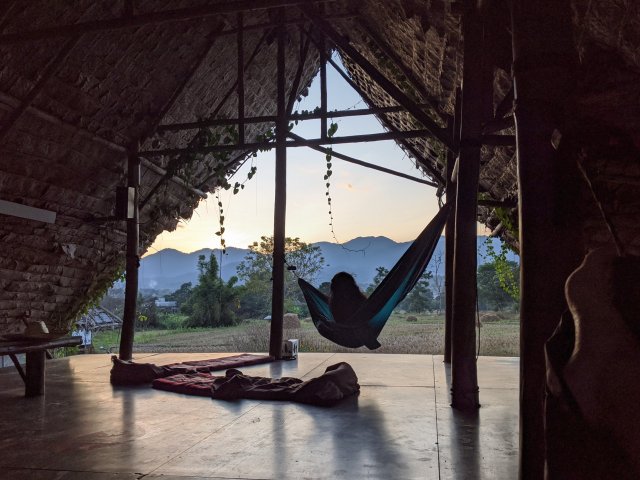
A perfect sunset from the hostel.

Pai in December is surprisingly chilly. Though the temperature got up into the 80s during the day, crystal clear skies and a high elevation allowed it to drop down into the 40s at night. This was the first time I’ve been properly cold since our trip to Denali in September, and I was grateful for my wool socks, fleece sweater and knit cap.My main activity in Pai was a two day outdoorsy adventure, kayaking one day and trekking through the jungle the next with a homestay in a mountain village in the middle.

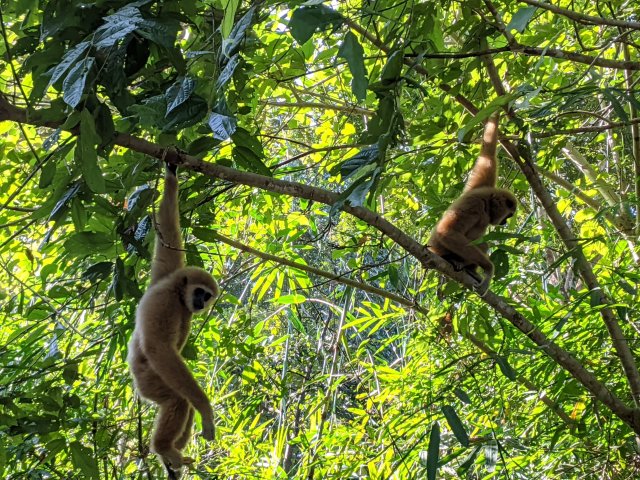
These gibbon monkeys hung out over the road to the river we kayaked, waiting for tourists to show up and toss them bananas.
A chilly morning after the homestay.
🎵It’s beginning to feel a lot like Christmas🎵
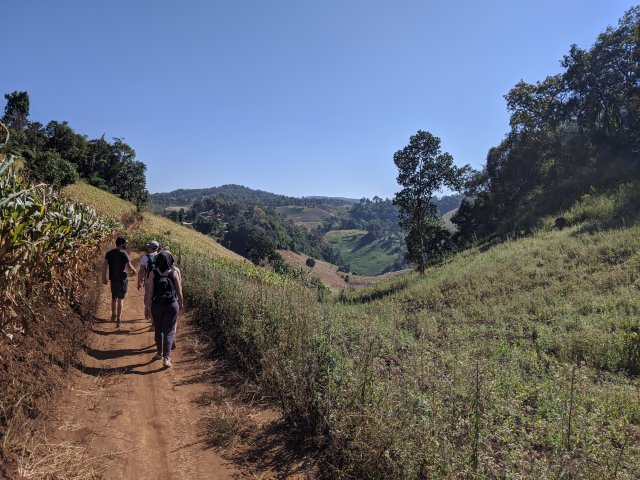
The beautiful farmland of Northern Thailand. Why yes, that is corn growing off to the left.
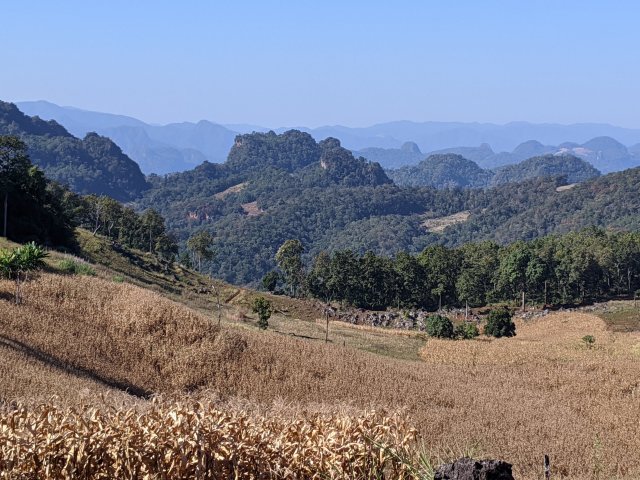
I will never get tired of these impossibly steep limestone mountains.
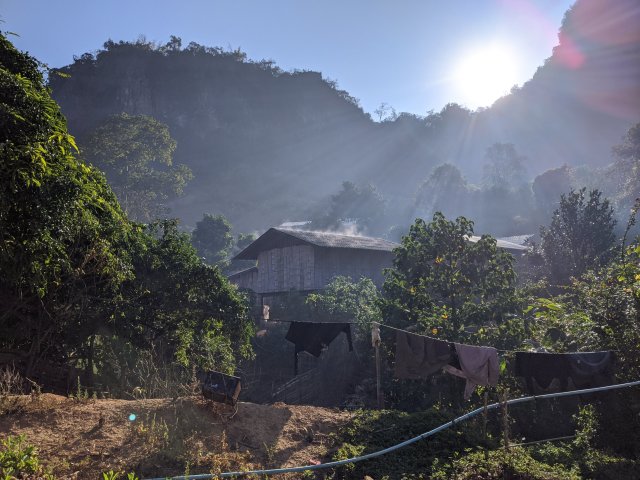
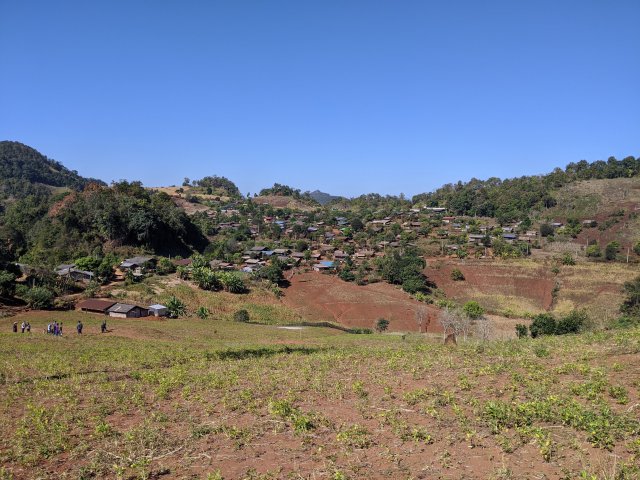
A tiny village up in the hills.
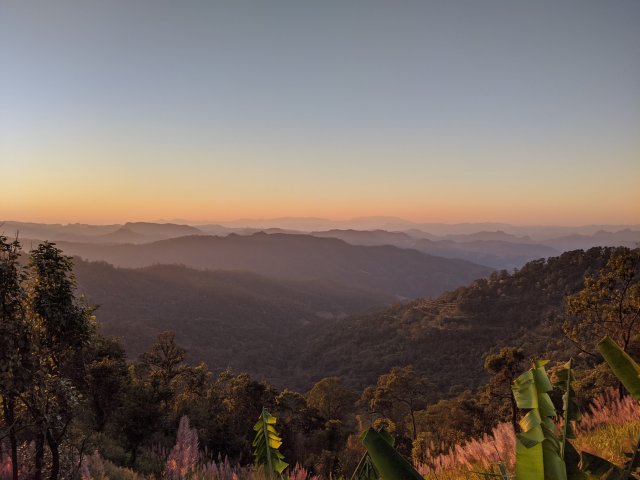
On the way back from the trek, we stopped at the top of a pass to watch the sunset. Then we rode into Pai in the back of a pickup truck, shivering all the way.

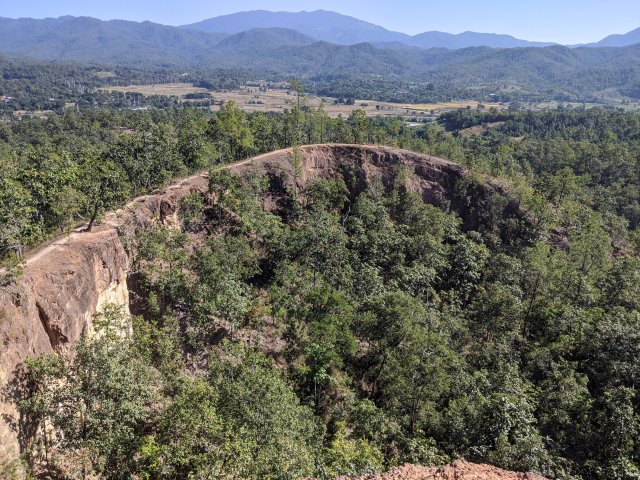
The next day I hung out with other travelers from my hostel. We wandered into town, rented scooters, and drove out to Pai Canyon to explore its strange twists and turns. Imagine the landscape of Utah with all its ridges and rock formations, then cover it in dense jungle and you’ll have a good sense of the terrain. Day’s end yielded one of the best sunsets I’ve ever seen, followed by the beauty of the dusty ridges lit by the almost-full moon, the stars above mirrored by the lights of distant villages in the surrounding hills. It was a truly magical moment. The drive back to town was stupidly cold (none of us had planned to be out that late), but that made the big bowls of soup and crackling campfire we found when we returned to the hostel all the more welcome.

The canyon is too big to be really photogenic, but this gives you a sense of the terrain.

Then it was back into the minivan, down the mountain passes to Chiang Mai where I’ll catch a flight to my next destination. I spent four nights in Pai, but could easily have stayed for a week if I wasn’t coming up against the end of my trip. It’s beautiful, culturally rich, and has a wonderful laid back attitude. I’ll definitely be back next time I’m in this part of the world.

Elephants

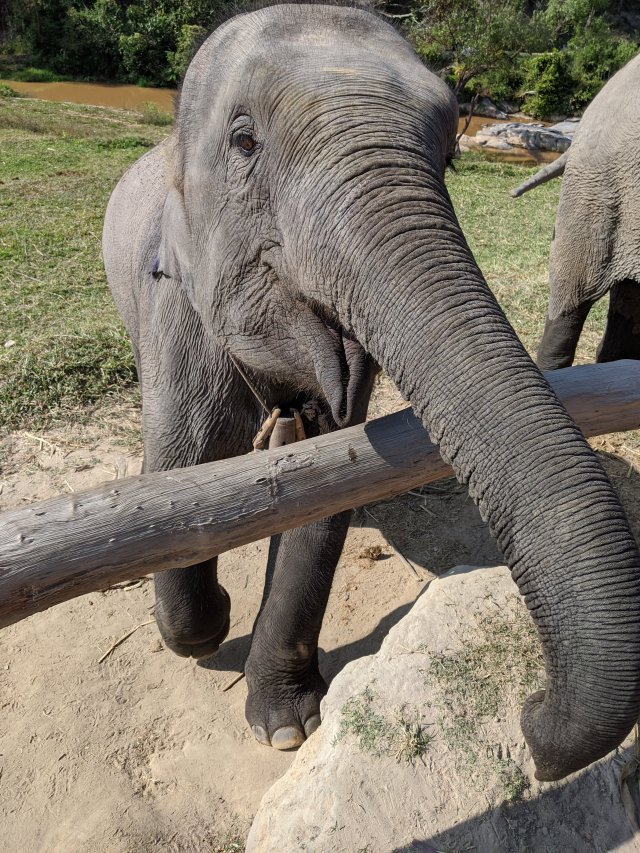
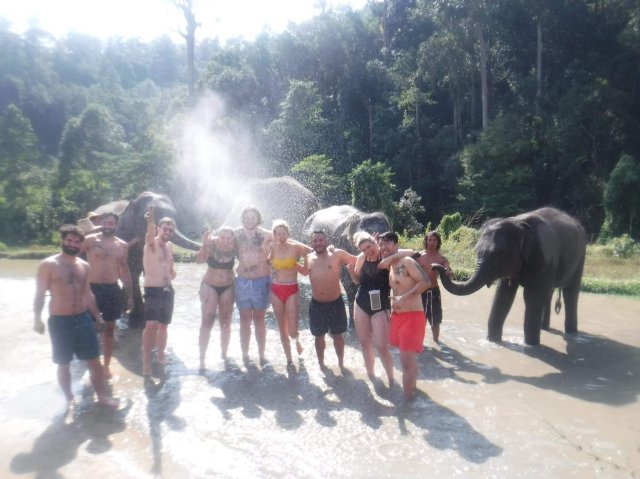
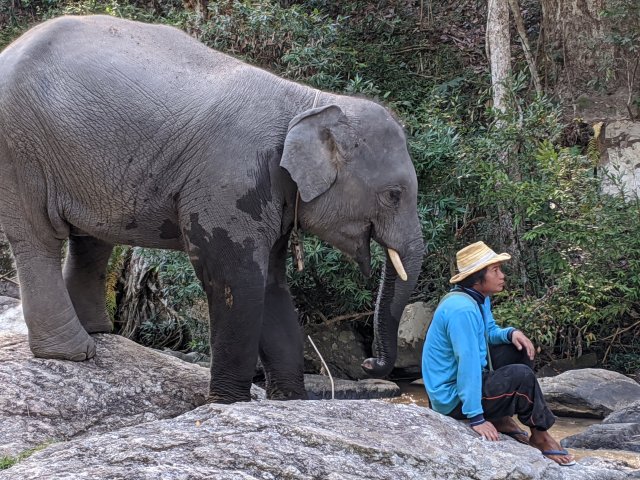
Yesterday I went to an elephant sanctuary, Into the Wild Elephant Camp near the city of Chiang Mai.

I knew I would it, but the experience was much more meaningful than I expected. Elephants are really big, even the babies, and they’re clearly intelligent in a way that’s very different to humans.

An elephant’s skin is leathery and tough but still supple. The hairs on their heads and backs are stiff and bristly. Their trunks are surprisingly dexterous, and incredibly powerful. And they’re remarkably quiet, their huge flat feet muffling their footsteps, to the point that this camp puts wooden bells around their necks so they can’t sneak up on you.

Into the Wild is well known for its ethics – their two adults (of a herd of 5) are both rescued working elephants, and they have a big tact of jungle far from the city where the elephants roam. It’s still not quite a natural setting. The herd has a few handlers to keep watch over them and keep them from harm, the camp buys much of their food to avoid over-grazing the land, and of course they spend a lot of time interacting with tourists, which pays most of the camp’s expenses. But there’s no riding, and it’s a lot closer to a natural state than many such attractions.

As they gave us the rundown before the elephants arrived in the morning, the camp’s owner asked us why we think it’s important not to ride the elephants. After all we ride horses, camels and donkeys, or use them as draft animals, in other parts of the world without thinking twice about it. Elephants are far bigger and stronger than those animals, caring a human would be almost trivial for them. What makes elephants so special that they can’t be ridden or worked? Do we truly care, or is it just easier to pass judgement on a foreign culture far from home? It’s a tricky question, and I don’t know that I have a good answer.

Seeing elephants was one of the big items on my list for this trip, and I would say I’ve checked it off in a major way. Spending a day with these incredible animals was one of the highlights of my trip, and I’m glad that I was able to do so responsibly.

Phnom Penh, Bangkok and Thanksgiving

Hi! It’s been a minute since my last post, so here is a quick update about what I’ve been doing.

I successfully made it from Sihanoukville to Phnom Penh without any trouble – an day riding on an air conditioned bus was easy to handle. I spent the next day exploring Phnom Penh, visiting the prison museum and the killing fields that are the legacy of the Cambodian genocide 40 years ago. I’ve been working on a blog post describing those events, but it’s depressing enough that I’m making little progress, which is part of why you haven’t seen an update in so long. Suffice to say it was horrific, and Pol Pot and the Khmer Rouge deserve all the scorn you can muster.

I finished my long day with a late flight to Bangkok – by the time I was through customs and in a cab to the city, it was almost 2 AM.

Unfortunately wandering around in the sweltering heat all day wasn’t the best thing for my still tender tummy. Nor was eating a bunch of super spicy Indian curry for lunch (tasty, but not wise). That night my traveler’s sickness returned with a vengeance. Fortunately my Bangkok hostel was comfortable, quiet, and had plenty of toilets, the perfect place to hunker down for a few days. This time I was determined to stay until I was truly better.

I should describe this hostel, since it was the setting for my time in Bangkok. It’s name is Luk, it’s a new-ish hostel run by experienced hosteliers, and it’s located right in the heart of Bangkok’s spectacular Chinatown. Instead of a common room it has a nice, slightly expensive rooftop bar/restaurant, mostly patronized by hostel guests but open to the public. They had live music most of the nights I was there. I would describe the vibe as “cool” but not “relaxed”.

My first day in Bangkok was Thanksgiving. Outside of venturing out for some noodle soup (which turned out to be fantastic), I barely left my bed. In the evening, feeling somewhat bored and somewhat sorry for myself, I ventured up to the rooftop looking for some conversation to cheer me up. What I found exceeded my wildest expectations: the staff cooked up a big Thanksgiving dinner, and everyone ate together. It was truly wonderful, and a bit of turkey and mashed potatoes did my stomach good.

Yes the turkey is wrapped in bacon, and yes it was delicious.

On Friday morning I called my family to wish them a happy Thanksgiving. It was good to see everyone and chat a bit, and of course to get a ton of sympathy for feeling like crap. Otherwise day 2 passed much as day 1 had. I felt a little better in the afternoon and walked the kilometer to the train station to book a sleeper ticket north to Chiang Mai for Monday night. I had heard they sell out fast, but I managed to get the last one.

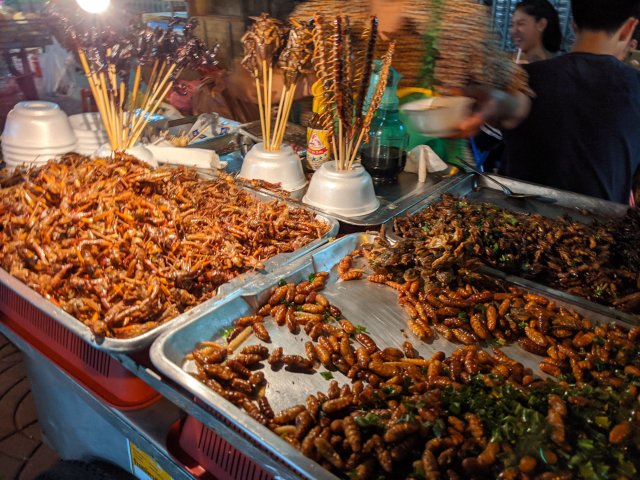
Finally on Saturday I felt well enough to do some tourist things. I wandered around the old town to a couple of the bigger wats, took a river boat back to Chinatown, and had a delicious afternoon nap. In the evening I ventured out to Yaowarat Road, a haven for street food. Bangkok’s street food scene is famous for quality and safety (there’s even one that’s Michelin starred), so I wasn’t worried about triggering a third wave of illness.

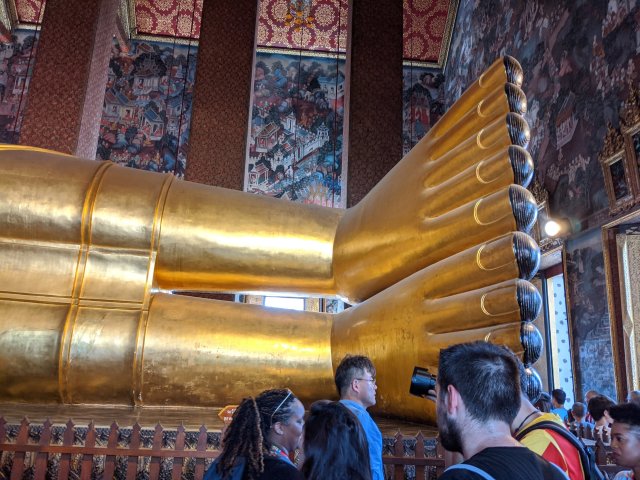
You know what they say about Buddhas with big feet…
Bugs anyone?

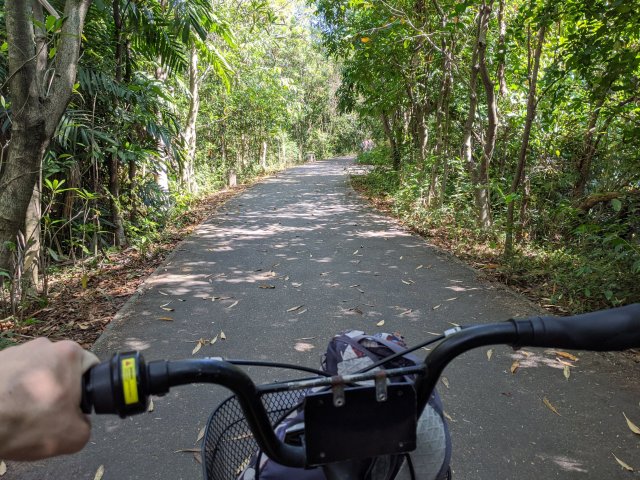
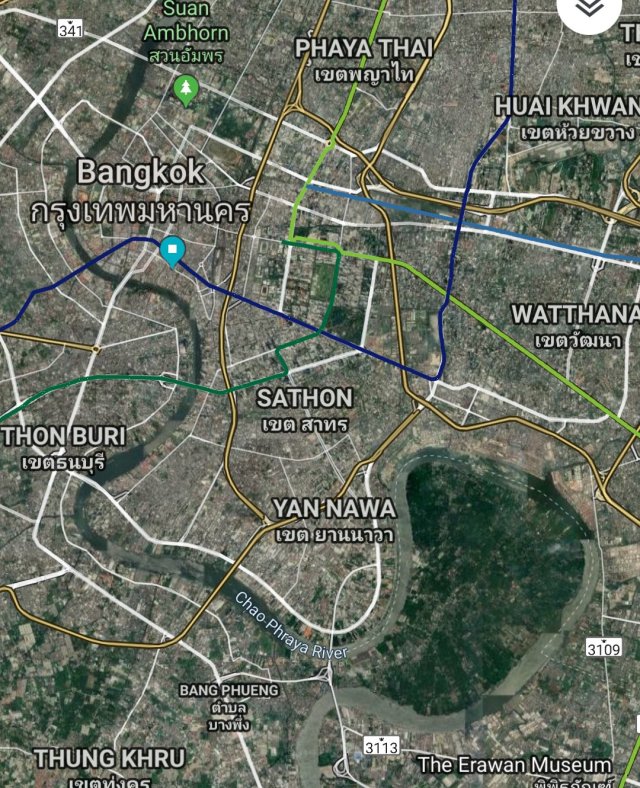
On Sunday, finally feeling properly myself, I caught a motortaxi and a quick ferry to Bang Krachao, Bangkok’s “green lung”, where I rented a bicycle and pedaled around for the day. Here a meander in the river almost creates an island, and the district is preserved as a carefully managed jungle in the heart of the city. There are some homes and businesses, as well as many oddities like a floating market and a Siamese fighting fish gallery, but for the most part it’s green space, a pseudo-wild space amidst the concrete jungle. It’s kind of like Discovery Park in Seattle if it were tropical and had a giant permanent farmers market in the middle. The kind of place where middle class Thai families bring their kids on the weekends as an outing. It was a lovely way to spend a day. In the evening I did a food tour of Chinatown, which was fantastic as always.

Much of the area is only accessible via narrow concrete trails raised above the swamp.
You can see from the satellite view why they call it the “green lung”.

Monday I walked to and hung out in Lumphini Park, Bangkok’s equivalent of Central Park, then caught the train in the evening. 14 hours later I was in Chiang Mai.

I really liked Bangkok. It’s a beautiful, clean, well-organized city. It has incredible food, a good metro and it’s the first place I’ve been in months where they actually clean the streets. I stayed out of the touristy areas (didn’t even visit Khao San Road), which I think was for the best. If you want somewhere exotic and different but still safe and easy to travel to, I don’t think you could do better. It was a very good place to recover my strength and confidence.

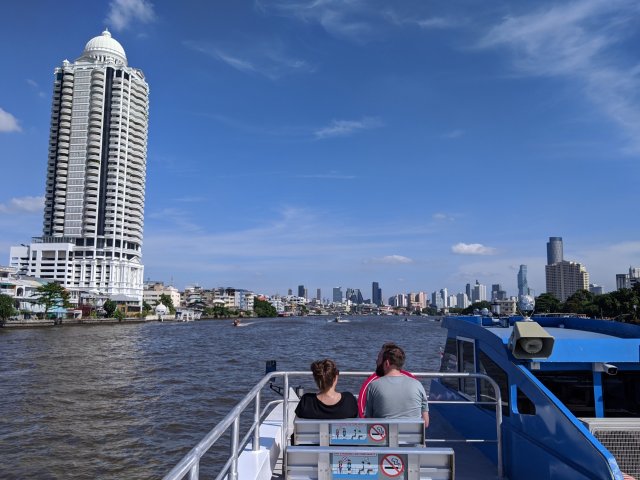
Bangkok from the river – a well-developed, modern city.

On the other hand, Bangkok is the only place in Southeast Asia where I’ve noticed people sleeping on the streets. It’s also the only place I’ve been approached by actual beggars – even in Cambodia people always wanted to sell me something. Just here and there, not nearly as many as back home, but it is obvious that this country’s prosperity hasn’t reached everyone. It’s also true that this is the first non-communist state I’ve been to in the region. It’s just a couple data points, so don’t go drawing conclusions, but it’s definitely something to think about.

Chinese Investment

Sihanoukville, Cambodia is perhaps one of the strangest places I have ever been. I am staying in a neighborhood called Otres, a long flat stretch of land along the beach to the southeast of the old town on the hill. Once it was a sleepy fishing town, the only tourists western backpackers particularly far off the beaten track. Now it is an entire city under construction all at once.

Every long block, sometimes up to 3 or 4 streets back from the ocean, is covered in the frames of high rise hotels, jockeying with each other for the best views of the ocean. Every road is under expansion, often doubling or tripling in width. The air is filled with the clang of hammers, the fumes of backhoes and dump trucks, and the screech of cutting metal. An endless stream of construction traffic clogs the highway out of the city, bumper to bumper as far as the eye can see through the middle of nowhere.

The money, of course, is Chinese, as are the anticipated tourists. So too I imagine are the architects and civil engineers, the steel and electrical components. An investment by China in China, though nominally outside its borders.

And yet the investment is taken gladly. It is sorely needed. Cambodia is the poorest country in Southeast Asia, and it certainly feels like the poorest place I have ever been. It is distressingly dirty, its waterways are choked with plastic garbage, its forests and fields riddled with landmines. A third of its children suffer from malnutrition, and it’s GDP per capita is just over half that of Laos, the next poorest country in the region (source). Tourism may not be the most noble industry but it beats the hell out of subsistence farming, and it certainly brings benefits. Electricity, roads, 4g and good plumbing are improvements that apply to locals and foreigners alike. And while Cambodia is known for corruption, I would bet that the expectation of profit and associated scrutiny does more to discourage grift than any number of government programs.

All the commerce of the city is squeezed into the small bits of land not marked for construction, perhaps one lot in three or four. Signs and menus are in Khmer and Chinese, scarcely a Latin glyph to be found (though dollars are still preferred to the local currency, and yuan not accepted). The usual apps are useless – half the restaurants on TripAdvisor are now holes in the ground, and Google Maps shows both roads that have been torn up and those that have yet to be completed. I don’t know how the tuk tuk drivers do it.

It makes me think of the book Rolling Rocks Downhill, by Clarke Ching. Small batches, he says, are the key to meeting tight deadlines when the stakes are high. This is just the opposite, an entire city built through waterfall. Maybe that wisdom doesn’t apply here – perhaps this is little more than an outflowing of excess industrial capacity, pocket change and hobby projects to the titans that built the glimmering east. Perhaps it has been arranged that should it fail the Cambodians will be the ones left holding the bag. Or perhaps, to the Chinese with their teeming megalopoli, this is a small batch.

What will they do, I wonder, when the seas rise? I have wondered this in many places on this trip, but here it seems an especially pressing question. The main town of Sihanoukville is on a hill, but the beaches stretch out along flatlands to the southeast, and this is where the new development is concentrated. Two meters would erase the beach entirely, a third would bring it to the steps of the hotels. What of ten, or twenty (edit: see footnote)? Will they build a wall, far out to sea, protecting their investment? Or will they allow it to sink into the waves? If the later, do they design with that in mind, buildings cheap enough to abandon after just a few short decades?

I think I would like to return, if that is in fact the case. To kayak down the avenues and marvel at the rotting carcasses of buildings that I walked between when they were but growing skeletons. It would be a humbling experience, perhaps a tourist attraction in its own right.

This is not Cambodia, really, not any more than Cabo is Mexico or Kuta is Bali. This is (or will be once its finished) a slice of China, injected here with the expectation of a full return on investment. The slice of human nature it represents is mirrored in America, in Australia, in Europe – it is the slice that seeks to extract, to use without understanding, to view a foreign people as a material resource rather than as potential friends. It is the slice that got us into this mess in the first place. Fitting, then, that it should sink beneath the waves.

But what then of the Cambodians who built it, who sweat under heavy loads in the hot sun, who set pipes with filthy water over the tops of their gum boots, who grind angles on umpteenth floors with neither harness nor goggles? Or of those who will follow, kowtowing before their Chinese customers for the chance to give their children a better life? Will they lament as the waters take this sudden metropolis? Only time will tell.

Edit: I got romantic when I wrote the post, then followed up and did my research. Even the most pessimistic climate scientists don’t predict more than 2.5 meters of sea level rise before the end of the century. Maybe I mixed up meters and feet in my memory? Or maybe it’s just easy to get caught up in your own side’s propaganda. A meter or two would leave Sihanoukville extremely vulnerable to storms, but not actually flooded. Looks like I won’t get to make my kayak trip after all. source 1 source 2

This makes me think of another recent read, Factfulness by Hans Rosling, the main thesis of which is that people, especially well-educated people and even people who are experts in relevant fields, consistently overestimate how bad things are in the world. Looks like I’m guilty as any.